

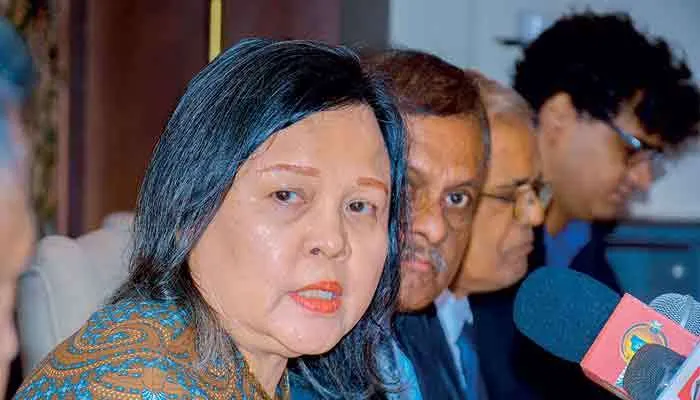
Indonesian Ambassador Dewi Gustina Tobing speaking at the Pathfinder Foundation Ambassadors’ Roundtable. Pathfinder Foundation Executive Director Dr. Dayaratna Silva and Dr. R.H.S. Samarathunga are also present Pathfinder Foundation Ambassadors’ Roundtable features insights from…
Indonesian Ambassador Dewi Gustina Tobing speaking at the Pathfinder Foundation Ambassadors’ Roundtable. Pathfinder Foundation Executive Director Dr. Dayaratna Silva and Dr. R.H.S. Samarathunga are also present
Pathfinder Foundation Ambassadors’ Roundtable features insights from envoy Dewi Gustina Tobing
The Pathfinder Foundation held its latest Ambassadors’ Roundtable at the Colombo Club, Taj Samudra, featuring Indonesian Ambassador and Diplomatic Corps Dean Dewi Gustina Tobing, who presented on Indonesia’s long-term national development strategy, Indonesia’s Golden Vision 2045.
She said that reflecting on the relevance of Indonesia’s experience for Sri Lanka, she observed that while the two countries have distinct development trajectories, they share common aspirations in strengthening human capital, improving food security, attracting investment, and building resilience against emerging challenges.
The Ambassador highlighted that Indonesia, with a population exceeding 280 million and a GDP of approximately $ 1.4 trillion, continues to remain the largest economy in Southeast Asia. Despite global uncertainties, the country has maintained resilient economic growth of around 5% in recent years, supported by industrial development and infrastructure investment.
In her address, Ambassador Tobing outlined Indonesia’s vision of becoming a developed, prosperous, and globally influential nation by 2045. She explained that the vision is being pursued under the leadership of President Prabowo Subianto, building upon successive administrations’ long-term development agenda.
The Ambassador outlined four foundational pillars underpinning Indonesia’s Golden Vision 2045:
Human development and mastery of science and technology – Building a healthy, educated, innovative, and technologically capable population.
Sustainable economic development – Transforming Indonesia into a productive, competitive, and resilient high-income economy while maintaining environmental sustainability.
Equitable development – Ensuring that the benefits of growth are shared across regions and communities through improved connectivity, public services, and social cohesion.
National resilience and governance – Strengthening institutions, governance, legal reform, anti-corruption measures, and national resilience in areas such as food, energy, water, climate, and maritime security.
A key component of Indonesia’s strategy is downstream industrialisation, which encourages domestic processing and value addition to natural resources rather than exporting raw materials. Ambassador Tobing cited the country’s nickel industry as a notable example, highlighting its transformation into an integrated ecosystem that includes smelting, battery production, and electric vehicle supply chains. Indonesia’s abundant reserves of nickel, palm oil, coal, and gold are being leveraged to attract foreign investment, support industrialisation, and create higher-value economic opportunities.
Looking ahead, Indonesia aims to become the world’s fifth largest economies by 2045, with projected GDP reaching between $ 9.1 trillion and $9.8 trillion and GDP per capita ranging from $ 23,000 to $ 30,000. Ambassador Tobing stressed that the components of Vision 2045 are currently being implemented are integral building blocks towards achieving these objectives.
Reflecting on the relevance of Indonesia’s experience for Sri Lanka, she observed that while the two countries have distinct development trajectories, they share common aspirations in strengthening human capital, improving food security, attracting investment, and building resilience against emerging challenges. As Indian Ocean States, both countries also share an interest in enhancing connectivity, expanding trade and investment, and promoting regional stability and prosperity, while creating mutually beneficial opportunities for deeper bilateral cooperation.
The presentation was followed by an interactive discussion on ASEAN’s role in regional affairs, Indonesia’s independent foreign policy, governance and anti-corruption efforts, social cohesion, the Regional Comprehensive Economic Partnership (RCEP) and opportunities for Sri Lanka, Papua’s development, and Indonesia’s democratic and economic transformation.
In her final remarks, Ambassador Tobing reaffirmed Indonesia’s commitment to strengthening cooperation with Sri Lanka.
“Sri Lanka is a good partner of Indonesia,” she stated. “We would like the progress and opportunities that Indonesia has achieved to be shared through collaboration. Our partnership is very important, and we look forward to strengthening it further in the years ahead.”
Opening the session, Pathfinder Foundation Executive Director Dr. Dayaratna Silva highlighted the significance of Indonesia’s remarkable development journey and the valuable lessons it offers countries across the Global South. He noted that Indonesia’s rise as a G20 member and its growing influence in regional and global affairs demonstrate the success of its long-term development planning. He further emphasised Indonesia’s leadership role within ASEAN and its contribution to establishing the RCEP, the world’s largest free trade agreement.