

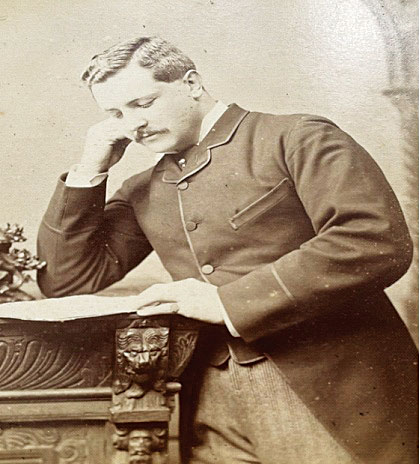
On this pious Poson season, I am taking a moment to remember an extraordinary colonial official, R.W. Ievers (1850-1905), Government Agent (GA) of North Central Province (NCP), who was a pioneer, along with a few other British colonial officers in the 19th century in bringing An…
On this pious Poson season, I am taking a moment to remember an extraordinary colonial official, R.W. Ievers (1850-1905), Government Agent (GA) of North Central Province (NCP), who was a pioneer, along with a few other British colonial officers in the 19th century in bringing Anuradhapura and the region from out of the darkness that engulfed it for centuries. Nearly two decades before Ievers started as GA in 1884, Emerson Tennant wrote Anuradhapura as a “city that has shrunk into a few scattered huts that scarcely merit the designation of a village.” He showed his intellectual versatility and love for such a city fallen on hard times by first writing the Anuradhapura Anthem (1890), a little-known celebratory poem of 12 verses. He followed it with his watermark contribution – The Manual of the North Central Province (1899, 276 pages), which was the first of its kind in the province and sowed the seeds for later generations to study the province’s life, history, and culture. After working at many stations and positions in Sri Lanka for nearly two decades, Ievers became the longest-serving GA in the province (2 months short of 10 years) between 1884 and 1893, showing us where his heart belonged – Anuradhapura. He shared the Anthem with his colleague, the first Archaeological Commissioner of Ceylon, H. C. P. Bell (1851-1937), who himself spent 23 continuous years in Anuradhapura as country’s first archaeological commissioner. Ievers’s calling and cohesion with Bell were mighty forces in turning archaeological work in the late 19th century into overdrive. These poems describe the city and the times before the restoration of its hundreds of archaeological sites, which began in the late 19th century. To some, these quatrains may look like a jovial piece of poetry written to kill time in this dreary province. Still, their grim assessment of the ruined monuments in the city, which in 1900, the Belgian geographer Jules Leclercq called “forgotten solitudes”, and the fervent hope Ievers had for their restoration, are remarkable. Bell was captivated by the poem’s theme and breadth. After Ievers’s death, Bell sent it to the Times of Ceylon Christmas Number in 1917. He did this because, as Bell’s granddaughters would call decades later, Ievers had been his ‘greatest friend.’ Ievers the Civil Servant and the Literati According to Leopold McClintock Bunbury Family Histories in Ireland, Robert “Bob” Wilson Ievers graduated from Queen’s University, Belfast, with a B.A. in 1872. Immediately after, he came first in the Ceylon Civil Service (CCS) examination and was posted to Sri Lanka. Later he would receive an M.A. degree from the same University. Until the mid-20th century, there were no native writers who took the time to write about the life and people in the North Central Province. Only a few from the southern parts of the country were drawn to the province to write primarily about its cities’ history. As literary resources in the province were nearly nonexistent, the few elites there were slow to take up the challenge. Ievers, too, faced this frustrating predicament, but fortunately, persistence proved his ally. But the Manual was also the product when there were no library resources in Anuradhapura. Elsewhere, in Colombo, there were only a handful, such as the Royal Asiatic Society and the Government Oriental Library, established in 1870, which preserved rare manuscripts. The few enthusiastic literati like Ievers could use the library facilities at Colombo Museum, Kandy Government Record Office, and small libraries in some Buddhist temples, which featured mainly Ola books. To gather information for the exhaustive volume, like the Manual, it is hard to imagine how many trips he made to Colombo (200km) or Kandy (144km), where the few libraries were beginning to stock their shelves and expand the country’s intellectual horizons. He went there by horse-drawn buggy, on bumpy horseback, often a cart ride, on a bony elephant’s back, or just by walking. To give an idea of how hard it must have been: In 1891, John Ferguson, co-editor of Ceylon Observer started from Dambulla at 8 p.m., sitting on a bullock cart, and reached Anuradhapura only at 5 a.m. the next day – a distance of 65 kilometers! There is no rich body of literature about Ievers, the man who mastered Sinhala on even keel with his friend H. C. P. Bell. J.R. Toussant wrote in Annals of the Ceylon Service (1935) that Ievers was one of the best Sinhala speakers in Sri Lanka. Thus, there was no better person at the time to write a Manual on the province he dearly loved. Manual speaks of the volumes of the harmonious din of his knowledge, tuned with groans and hisses of the people of the province, their politics, language, culture, and history. Cooler Intellect and Harsh Living While introducing the poems in 1917, the Times of Ceylon summarised the working environment Ievers endured while compiling them. In Anuradhapura, he lived in “semi-isolation.” The Northern Railway line would reach the city only 15 years after the Anthem. But the humility with which he worked is well documented in his writings. Once, he regretted the “incompleteness” of his work and urged his successors to bring it up to date. But those who followed him found it as complete as any of its kind could be. As early as the first decade of the 19th century, when pedagogical investment in Jaffna, 200 km north of Anuradhapura, with nearly 3000 students in missionary schools, was thriving, the first school in Anuradhapura was started only in 1850, and a missionary school in 1853. Still, it would take nearly half a century before the province’s academic and literary landscape began to show signs of enlightenment. With those kinds of shortcomings and life simple and in remote control, for Ievers, completing the Manual must have been like eating an elephant one bite at a time. Thus, Ievers worked in a region that was not a fertile ground for learning. Professor Ukkubanda Karunananda refers to an anecdote that in 1863, R.W. Morris, Assistant Agent for Nuwarakalaviya, wrote to the Government Agent in the Northern Province (Nuwarakalaviya was part of the Northern Province then), citing difficulty in finding a person for the position of Arachchirala, the headman, who is fluent in reading and writing the mother tongue of the country! The reach of education to rural areas was ancient and minimal. My grandfather, S. K. Dingiri Banda (b. 1901), told me a colonial school inspector riding a horse to Kahapathwilagama school with only 12 boys, including him, 8 km east of Galkulama on the gravel road that would become A-9 in 1985. As hinted in the Anthem, the recreational activities of the colonial officers were primitive, so much so that at an impromptu golf link in a recently cleared forest area between Ruwanweli Seya and Thuparama, they chipped golf balls onto greens separated by exquisitely carved stone pillars half buried in the earth. But Ievers resented golfing in the sacred city. Ievers worked under the most difficult and dangerous conditions for himself and his family. Danger from wild animals was everywhere, and colonial officers and their families faced life-threatening situations. A few times, family faced threats from bears and snakes, a familiar sight in those days. R. W. “Bob” Ievers (c. 1890). Photo: Turtle Bunbury It was a time in the NCP when diseases like malaria and cholera were rampant. Paul Goldsmidt, who was appointed in 1875 to record stone inscriptions in the NCP, died of malaria two years later. In the mid-19th century, even government offices in Anuradhapura were temporarily closed when there was a threat of disease or flooding of the Malwathu Oya. Sometime after 1902, Ievers himself, then Acting Colonial Secretary, fell ill and returned to the UK on sick leave, where he died in 1905. Ievers watched as often some communities were decimated. Villagers abandoned their homes outright due to torments like diseases. My grandfather once told me that when he was a teenager, he was familiar with the small village of Kidapolagama, two kilometers south of my village of Maradankalla (then called Maradankadawala) in Kanadara Korale. Census records show this was a lonely village of four homes (17 people) in 1901, three (10 people) in 1911, in an elephant-infested area. At the time of the 1921 census, Kidapolagama village had been deserted. It still is. Grandfather told me that, sometime after the 1911 census, a cholera outbreak in Kidapolagama killed six of the ten residents in two weeks. Scared of the dreaded fever and death, and probably for superstitious reasons, the other four residents picked up and walked out of the village. Ingenuity, Honesty & Mischief The grit and ingenuity of colonial officers working in ruined cities in Sri Lanka were their brands. Friend of Ievers, Bell, never used a measuring pole to depict in photographs the layout of structures or statues they dug out or cleared of brush. He used a human figure instead in the photo to convey the site’s proportional size and its structure(s). On the other hand, Ievers showed an extraordinary dedication to duty that even a friend would dare stand in the way. Once, he recommended that Bell be prohibited from continuing his fieldwork for failing to submit a report on a previous project, and even recommended that his promotion be held in abeyance! But during Bell’s formative years, when he wrote to Governor threatening to resign over salary issues, Ievers prudently wrote to the Governor, stressing the value of Bell’s work. Defending the works of colonial civil servants like Ievers in remote provinces, Senarath Paranawithana fittingly wrote that, “great credit (are) due to these pioneers for their contribution to our knowledge of ancient culture of the Island, which often the result of work undertaken at great personal risk and sacrifice, and in circumstances of which the difficulties can hardly be imagined by those who pursue their studies of Ceylon history in well-equipped libraries in Europe.” Ruwanveli Seya pre-1871 Photo: Joseph Lawton & British Museum Ievers was drawn to the forest and its people to such an extent that he had three tenures totalling seven years as GA in the NCP. The only other colonial officer who loved the village so much was Leonard Woolf, who came to Sri Lanka a year after Ievers left. Woolf wrote what Ievers had already seen and experienced – “a world of great beauty, ugliness, and danger. The beauty was extraordinary, and you never knew behind what tree or bush or rock you might not suddenly see it.” In such a trying, charming, and tempting environment, it is not unusual for one to act in a silly or unbecoming way. Ievers was not immune to this dictum. He was ready to accept responsibility for his letdowns. His critics once blamed him for digging a trench at Abhayagiriya. Once, while proposing the vote of thanks for Bell’s first Interim Report on Sigiriya at the Royal Asiatic Society meeting in 1896, Ievers publicly admitted the shame of scratching his own name on the Mirror Wall Gallery at Sigiriya. How vexed Bell must have been to hear this. In those days, after climbing rickety ladders precariously hung by creaking ropes for dear life to reach the centuries-old frescoes chamber under the scorching heat of the rock, a man, resorting to childish mischief to scratch his name on the wall amidst hundreds of etchings, got a pass from me. To Honour the man In my view, while Ievers’s Manual is the primus and the masterpiece of documenting the life and history of the province until then, his most original and singular contributions are the two elements in it – the Plan of a village paddy field (facing page 172), structured transcription of it on paper for the first time in Sri Lanka, and enriching the linguistic fingerprints of the province – compilation of the first ever glossary of its native words (p. 264). The Plan is a linear illustration of a field from the horowwa (sluice) to the end of the field at kurulu paluwa, with parts named in all sections in between, all the way to kattakaduwa, the land below the fields awaiting asvaddumization. Every writer since then has used this Plan, in some form or another, to describe aspects of paddy cultivation in the Dry Zone of Sri Lanka. John Still, who assisted Bell in deciphering the Sigiri graffiti (poems) inscribed on the Mirror Wall at the rock fortress, called the colonial officers working in the NCP, such as R. H. Freeman, Government Agent (1915-1919) at Anuradhapura, ‘Knights-errant and Champions of the Jungle People’s rights.’ Ievers fell into this category decades before Freeman made a name for himself. Freeman chose to retire in the NCP, committing himself to politics and social service. He was so popular in Anuradhapura that he was called “Preeman Mahattaya,” and the city rightfully named a street after him. Ievers, too, is every bit deserving of a street or a square named after him! It is disheartening that Sri Lanka’s celebrated ballad genre, known as Sandesa Kavya, letter carrier poems, makes no mention of an avian messenger flying over Anuradhapura, describing in verses the beauty of the city. R.W. Ievers, working under harsh and dreaded conditions, corrected that disappointment by writing his poem, an Anthem no less, about Anuradhapura, a remarkable feat and an honor the Sandesa poets failed to bestow upon this mother of all Sri Lankan cities. Ievers garnishes his poem with the physical condition of the ruined structures, some buried and out of sight, or scattered across the old city landscape at the time, giving us a vivid picture of a millennia-old civilization, under meters of earth and half in decay, surviving without any royal or government patronage. Verse below starts Anuradhapura Anthem: Anuradhapura! City grand and vast, Lanka’s famous Capital, in ages of the past: In the “Mahawansa” the story has been told, Of thy palaces, and temples, and pinnacles of gold. I am unable to fathom that there is no monument of any kind to remember and celebrate these Colonial pioneers who worked tirelessly and fearlessly to bring the NCP out of obscurity in the late 19th century. Now, when we visit the sacred city of Anuradhapura, let us not forget people like Ievers, in the window of time they were at the NCP, who made contributions with enthusiasm that are more than any one of us could make in a lifetime. Lokubanda Tillakaratne writes about ethnography and history of Nuwarakalaviya. Lokubanda Tillakaratne