

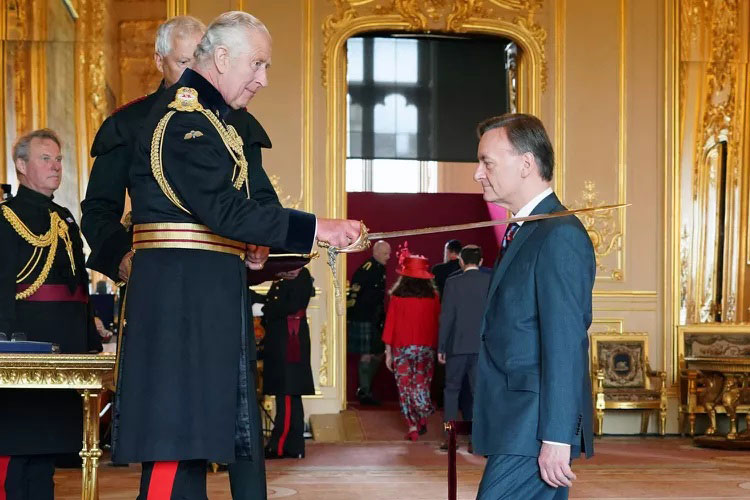
The word “Sir” is classically and linguistically associated with Great Britain and His Majesty’s English Language. As an esteemed prefix, it generally refers to a Knight, but very strictly speaking, that is perhaps a rather narrow and restricted synonym. While a Knight of the Br…
The word “Sir” is classically and linguistically associated with Great Britain and His Majesty’s English Language. As an esteemed prefix, it generally refers to a Knight, but very strictly speaking, that is perhaps a rather narrow and restricted synonym. While a Knight of the British Empire is the most common type of knight people encounter today, Great Britain actually has several different orders of knighthood, as well as an ancient rank that does not belong to any such order at all. When someone is dubbed a knight in Britain and referred to as “Sir” X, Y or Z, they generally fall into one of three categories. The first is a Knight Bachelor, undoubtedly the oldest rank. This is the most common form of knighthood awarded for public service, arts, or science. In that context, one should think of Sir Elton John, Sir Paul McCartney, or Sir Ian McKellen. It is not a part of an explicit “Order”, like that of the British Empire. It is the oldest mechanical form of knighthood, dating back to the 13th century under King Henry III. The recipients are simply styled as Sir, followed by the first name, such as Sir Ian, without any post-nominal letters like KBE or OBE attached to the end of their name. The second is a Knight Commander of the Most Excellent Order of the British Empire (KBE). This is a specific group, established relatively recently in 1917 by King George V, to fill a gap for rewarding civilian and military effort during World War I. To qualify to be called “Sir” within this specific order, a man must be appointed as a Knight Commander (KBE) or a Knight Grand Cross (GBE). The third is a group of Chivalric Orders, the so-called Elite and Ancient Orders. Several highly exclusive, ancient orders of knighthood sit much higher in precedence than the Order of the British Empire. These include the Most Noble Order of the Garter, the pinnacle of British honours founded in 1348, and scrupulously limited to the Monarch, the Prince of Wales, and only 24 other companion members. Then there is the Most Ancient and Most Noble Order of the Thistle, the highest chivalric honour in Scotland. The last of this group is the Most Honourable Order of the Bath; typically awarded to high-ranking military officers and senior civil servants. The Summary Rule of this entire scenario is that every Knight of the British Empire (KBE) is a British Knight, but not every British Knight is a Knight of the British Empire. If you see a modern British knight who does not have military or diplomatic ties, odds are high that they are actually a Knight Bachelor. With reference to the title of this presentation, now for the flip side of this, as we see things in our region of the globe. In Great Britain, it is the standard form of address to refer to a Knight as Sir John, Sir Ian etc. However, in Sri Lanka, as well as in the Indian sub-continent, very often people use the word “Sir” as a suffix or a postfix to honour someone and frequently use “X Sir”; the name followed by the word “Sir” as a suffix or postfix. It is a fascinating linguistic oddity, and Sri Lanka is definitely not alone in this, and most definitely, we are second to none in that outlook. While using “Sir” as a suffix or postfix (e. g., De Silva Sir, Nihal Sir) completely cartwheels over the standard British etiquette, where “Sir” must strictly prefix a first name. This charming practice of using it as a suffix is actually widespread across South Asia and parts of Southeast Asia. It is a classic example of dialectal crossbreeding, where local grammatical structures and cultural norms go to the extent of rewriting even the rules of the standard English as a language. In a very broad sense, this phenomenon is very definitely seen in the Indian Subcontinent (E.g. Sri Lanka, India, Bangladesh, Nepal, Bhutan and Pakistan). This is arguably where the “Name + Sir” phenomenon is largest and perhaps even the strongest. Across Sri Lanka, India and Bangladesh, you will constantly hear people refer to superiors, teachers, or public figures as Karu Sir, Vijay Sir, Sachin Sir, Shahrukh Sir, or Ahmad Sir, etc. Then there is the Indian “Ji” Factor: In Indian languages like Hindi or Punjabi, it is a strict cultural taboo to call an elder or a superior by their bare name. People naturally append the respectful suffix “Ji” (e. g., Gandhi-ji, Sharma-ji). It is then no surprise at all that when switching to English, the Indian mind seamlessly swaps the local suffix Ji for the English honorific Sir, thereby turning Vijay-ji into Vijay Sir. In Hong Kong, a very specific variation of this exists within the police force and civil service. Influenced by decades of British administration, mixed with Cantonese naming customs, junior officers and the public address superiors by their surname followed by “Sir”, such as “Wong-Sir” or “Chan-Sir“. There is even a universal colloquial generic term, “Ah-Sir“, used commonly to address male police officers or teachers. In the Philippines, while the syntax is slightly different, the sheer density of “Sir/Madam, Ma’am” usage matches that of Sri Lanka. Filipinos deeply value hierarchical courtesy. While they might say “Sir Jason“, it is incredibly common to use “Sir” almost like a pronoun or a mid-sentence suffix punctuation mark when addressing superiors, bosses, or clients, to ensure that respect is suitably maintained conscientiously. The mismatch between British English and South/Southeast Asian English comes down to how different native cultures view status and intimacy. In South Asia, especially in Sri Lanka, there is the Linguistic Tradition of the suffix, where an extension in the nation’s own language is inserted into a word to enhance its status. In languages like Sinhala (-thuma / –mahathmaya), in Tamil (-ayyah / –avargal), and in Hindi (-ji), respect is always attached to the end of a name. It simply means that forcefully bringing a sleek word that implies social deference to the front, like Sir John, feels syntactically peculiar or even inappropriate to a native speaker of these local languages. The “First Name Dilemma” is another type of rather quaint occurrence. In the West, calling your boss simply “John” is seen as a gesture that is egalitarian, free and open. In South Asia, calling an elder or superior by their first name feels somewhat jarringly rude. Conversely, using just “Mr Perera” can also feel too cold, official and even distant. “Perera Sir” or “Silva Sir” strikes the perfect culturally mitigatory concession, as it maintains a warm, personal connection by using the surname while also overtly and safely conveying a layer of professional public respect by adding the word “Sir” as a suffix or a postfix. Yet for all that, it is worth noting that fundamentally, all languages are symbolic expressions of human thought and human intelligence. Whether expressed as spoken, written or sign language, all dialects are means of human communication. The type of words like “Sir” that we use in the English Language and the real context in which they are used indicate our thoughts in our human intellect. When they are used appropriately, they reflect our commitment to uninhibited respect and even admiration. While the British people and even their Monarch might feel quite a bit confused to hear someone called “Perera Sir”, right across Sri Lanka and its neighbouring nations. Yet for all that, it is simply the most natural and fusion technique to bridge and integrate traditional deference and admiration with modern expressive English. by Dr B. J. C. Perera Specialist Consultant Paediatrician and Honorary Senior Fellow, Postgraduate Institute of Medicine, University of Colombo, Sri Lanka. An independent freelance correspondent.