

For decades, Sri Lanka has been marked on the world map as the “Pearl of the Indian Ocean”—a tropical paradise for travelers. However, recent data and chilling revelations suggest that a dark cloud is forming above that beautiful image. Evidence is emerging that horrific cyber c…
For decades, Sri Lanka has been marked on the world map as the “Pearl of the Indian Ocean”—a tropical paradise for travelers. However, recent data and chilling revelations suggest that a dark cloud is forming above that beautiful image. Evidence is emerging that horrific cyber crime networks, previously centered in Southeast Asian countries like Myanmar, Cambodia, and Laos, are now shifting their operational hubs toward Sri Lanka. Today, the island is increasingly becoming a secret makeshift headquarters for international “Telecom Fraudsters” and syndicates operating “Pig Butchering” (financial investment fraud) schemes. Based on raids conducted in the country from 2023 to April 2026, technical data, and information obtained under the Right to Information (RTI) Act, this investigation examines how these networks operate and the threat they pose to both the country and the global community. Global Crackdown and Sri Lanka as the “Entry Point” Following intense crackdowns by China and Southeast Asian nations on criminal zones like Myanmar’s “KK Park” and areas in Dubai, these criminals have dispersed in search of new safe havens. Sri Lanka has become a primary target for several key reasons:
Economic Vulnerability: In light of the country’s economic situation, a relaxed scrutiny regarding any foreign investment or cash inflow has benefited criminals. Visa Loopholes: The ease of engaging in business activities while on tourist visas and the opportunities to overstay. Infrastructure: Sri Lanka boasts high internet speeds and communication facilities—essential factors for cyber operations. Technical Literacy Gap: A lack of digital awareness and negligence among local internet users makes them easy prey, often leading to their bank accounts being used for money laundering (mule accounts).
Recent Raids and Revelations Since mid-2024, several raids by the Sri Lanka Police and the Criminal Investigation Department (CID) have revealed the scale of these networks:
Kandy (2024): A luxury hotel and several houses in the Hanthana area were raided, resulting in the arrest of 126 Chinese nationals. Over 200 computers and 500 mobile phones were seized. Panadura & Negombo: Over 200 foreigners were arrested during raids on a three-story house in Panadura and tourist guest houses in Negombo. Iranavila, Chilaw (April 3, 2026): This marks one of the largest recent raids. 150 individuals, including 133 Chinese nationals, 13 Vietnamese, and one Malaysian, were arrested at a luxury hotel in Ambakandavila.
A common feature in these raids was the presence of “SIM Boxes”—devices capable of operating hundreds of SIM cards simultaneously to send thousands of fraudulent calls and messages.
Modus Operandi These criminals operate under a sophisticated multi-layered structure:
Trafficking & Forced Labor: They post ads for “Online Marketing” or “Data Entry” jobs on Telegram, Facebook, and LinkedIn. Foreigners (Chinese, Thai, Indian) are lured with high salaries, after which their passports are seized, and they are held like slaves in “Scam Centers” to carry out frauds. “Pig Butchering”: This is the primary revenue stream. Scammers build a romantic relationship or deep friendship with victims online before convincing them to invest in fake platforms. They allow small initial profits to build trust, only to vanish once the victim deposits a large sum. Anonymity: They use VPNs to show IP addresses in Europe or America while operating from Sri Lanka. They also hack social media accounts (WhatsApp, Facebook) to solicit money. Our investigation revealed many cases where hacked WhatsApp accounts were used to trick victims into depositing money into local private bank accounts via “Phishing” links.
Geographical Hotspots in Sri Lanka
Zone Primary Locations Nature of Activity
Zone A – Colombo & Suburbs Wellawatte, Bambalapitiya, Colombo 07 High-speed internet in luxury apartments. Conducts ATM fraud and high-end financial scams.
Zone B – Hill Country Kandy (Hanthana, Peradeniya) Isolated large bungalows and boutique hotels. Holds hundreds of workers away from public view.
Zone C – Coastal Belt Negombo, Panadura, Galle Operated as “Call Centers.” Easy to blend in due to high tourist traffic.
Zone D – NW Coast Chilaw, Iranavila A newly identified zone using isolated beach side luxury hotels as operation hubs.
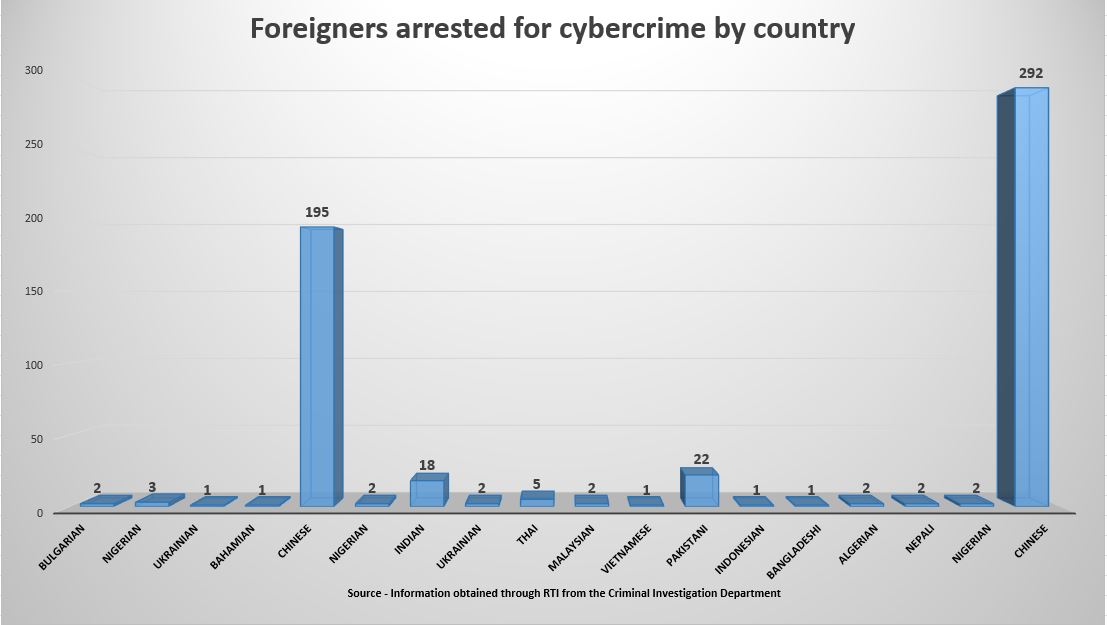
The Growing Threat: Data and Statistics According to data obtained from the CID via RTI, there has been a massive surge in arrests over the past three years. Between 2023 and April 3, 2026, approximately 412 foreigners were arrested for online fraud alone.
2023: 7 arrests 2024: 253 arrests 2025: 2 arrests 2026 (up to April 3): 292 arrests Total arrests during this period: 554
Furthermore, data from the Department of Immigration and Emigration shows that between January 2023 and December 2025, 270 foreigners were deported for visa violations. In 2026 alone, another 125 Chinese nationals were deported. In total, 385 foreigners (including 307 Chinese, 43 Thai, and 18 Vietnamese nationals) were deported during this period. These raids confirm that Chinese and Nigerian nationals are the primary operators of these networks. Reports from a Chinese special police team suggest these centres are directly linked to international criminal syndicates in Myanmar and Cambodia. (A Chinese national who was involved in an illegal travel advisory service that meticulously and secretly repatriates money received from foreign tourists visiting the country to other countries was arrested in Kandy.)
Hidden Links and Network Analysis This is not a random collection of individuals but a highly organised structure. “Masterminds” in Myanmar or Dubai register Shell Companies in Sri Lanka’s IT sector to bring in operators on Business Visas. Local Facilitators: Critical players include real estate agents who rent out houses for exorbitant rates (LKR 500,000 to 1,000,000 per month) without informing the police, and individuals who provide thousands of SIM cards using fake data. Money Laundering: Defrauded funds bypass the banking system and are converted into USDT (Stablecoin). They are then moved through digital wallets (Layering) to accounts in Southeast Asia or tax havens. How to fraudulently collect money through hacked WhatsApp accounts
Challenges and Legal Gaps
Technical Capacity: A significant gap exists in the ability of average police officers to identify the complex data encryption used by criminals. Jurisdiction: While ground operators are caught, the “controllers” remain abroad, making it difficult to uproot the network entirely. Legal Delays: Obtaining approval to prosecute specific technical crimes under the Code of Criminal Procedure is time-consuming. Existing laws do not fully cover emerging cybercrimes. And some officials are not conducting raids on existing connections with these networks, and are only deporting arrested accomplices, mainly Chinese nationals, without referring them to judicial proceedings.
The Way Forward To prevent Sri Lanka from becoming a cybercrime hub, the government must consider:
Stricter Housing Regulations: Mandatory police reporting of the visa type and employment of foreigners renting houses or apartments. SIM Control: Limiting the number of SIM cards an individual or entity can obtain and strictly controlling the import of “SIM Boxes.” International Cooperation: Setting up joint cyber investigation units with Chinese and Indian security forces and Interpol. Legal Reform: Rapidly amending laws related to cybercrime and financial fraud to match modern technological requirements.
Sri Lanka has reached a critical crossroad, evolving into a “Digital Sweatshop” for international criminals. This is not just a financial issue; it is a grave threat to national security, the stability of the financial system, and the country’s international reputation. Unless authorities act immediately, the world will recognize our island not as a traveler’s paradise, but as the next “Cybercriminal Paradise.” It is a collective responsibility to ensure our motherland does not become a sanctuary for criminals. A Special Investigation into International Telecom Fraud Operations in Sri Lanka By Rahul Samantha Hettiarrachchi