

News Current El Niño Status in Sri Lanka Published 24 hours agoon 2026/07/16 At present, El Niño conditions have developed and are classified as being at a weak level. Forecasts indicate a 63% probability of a very strong El Niño event developing during the period from November…
News Current El Niño Status in Sri Lanka
Published 24 hours agoon 2026/07/16
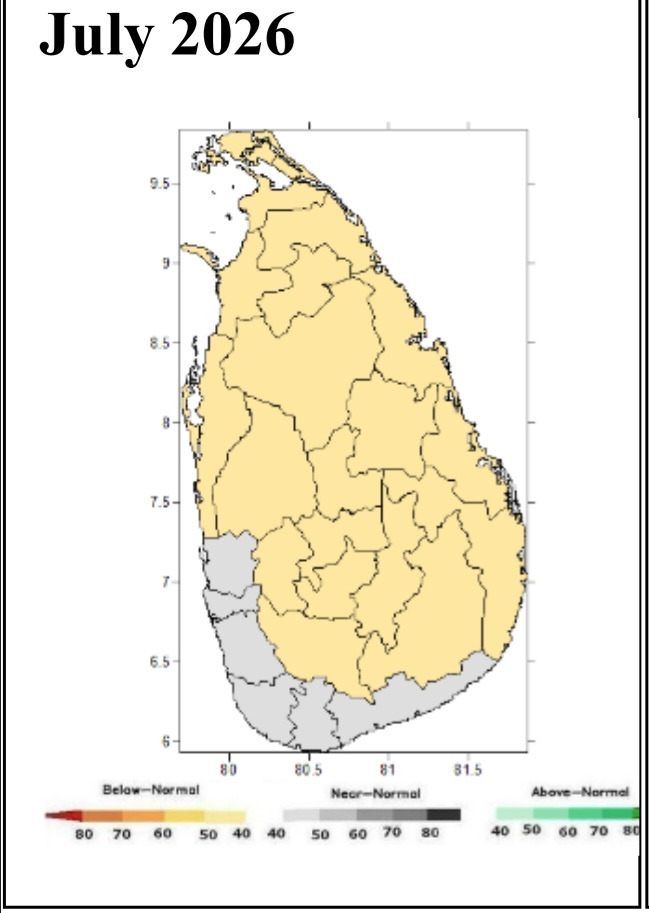
At present, El Niño conditions have developed and are classified as being at a weak level. Forecasts indicate a 63% probability of a very strong El Niño event developing during the period from November 2026 to January 2027. According to the National Oceanic and Atmospheric Administration (NOAA), there is approximately a one-third probability that El Niño will remain below a very strong intensity. Typical Climatic Conditions Associated with El Niño Based on analyses of past El Niño events that occurred between 1950 and 2025: • Rainfall during July and August may be below normal, particularly in the dry zone areas. • From October onward, rainfall is generally expected to be above normal. • If a positive Indian Ocean Dipole (IOD) develops, enhanced rainfall conditions may continue until December. Sectors Requiring Attention • Appropriate measures should be taken for water resource management during July and August. • Increased rainfall expected from October onward may lead to floods and landslides, requiring preparedness and close monitoring. The forecasts are important for sectors such as, Agriculture /Water management /Livestock /Health /Energy /Other climate-sensitive sectors • Attention should be paid to official information issued by the Department of Meteorology. Actions by the Department of Meteorology The Department of Meteorology continuously monitors the evolving situation and issues: • Weekly and monthly seasonal forecasts and Monthly analyses of rainfall data to monitor meteorological drought conditions. As weather conditions are influenced not only by El Niño but also by other climatic factors, updated forecasts and advisories are regularly shared with relevant stakeholder organizations (Irrigation/ Water Management Committee /Department of Agriculture/National Building Research Institute/Disaster Management Centre (DMC)/Ministry of Health /Sri Lanka Land Development Corporation…etc). The Department also provides technical support to the committee established through a Cabinet decision to address climate-related impacts. The Department’s monthly rainfall outlook for July to September 2026 is attached Monthly Rainfall Forecasts for July, August and September 2026 Month Rainfall forecast July 2026
During July 2026, there is a higher probability of having near normal rainfall across most parts of the Western and Southern Provinces. The remainder of the country is expected to experience below normal rainfall. August 2026
There is a higher probability of having below normal rainfall across most parts of the country during month of August 2026. September 2026
There is a possibility of above-normal rainfall across most parts of the Western and Southern Provinces, while near-normal rainfall is expected in the Sabaragamuwa Province. Below-normal rainfall is likely in the remaining areas during September 2026. Note: These long-range forecasts may change due to strong day-to-day atmospheric variability associated with the movement of weather systems such as atmospheric disturbances, low-pressure areas, and depressions, as well as intra-seasonal oscillations such as the Madden–Julian Oscillation (MJO). Therefore, in addition to the weekly and monthly forecasts, it is important to pay attention to the Department’s official announcements, weather advisories and warnings, as well as the daily weather forecasts issued by the Department of Meteorology.
Weather A few showers may occur in the Western, Sabaragamuwa and North-western provinces and in Kandy, Nuwara-Eliya, Galle and Matara districts.
Published 24 hours agoon 2026/07/16
WEATHER FORECAST FOR 16 JULY 2026 Issued at 05.30 a.m. on 16 July 2026 by the Department of Meteorology A few showers may occur in the Western, Sabaragamuwa and North-western provinces and in Kandy, Nuwara-Eliya, Galle and Matara districts. Dry weather will prevail over the other areas of the island. Strong winds about (40-50) kmph can be expected at times over the Northern, North-central and North-western provinces and in Matale, Hambantota and Trincomalee districts.
Weather A few showers may occur in the Western, Sabaragamuwa and North-western provinces and in Kandy, Nuwara-Eliya, Galle and Matara districts
Published 2 days agoon 2026/07/15
WEATHER FORECAST FOR 15 JULY 2026 Issued at 05.30 a.m. on 15 July 2026 by the Department of Meteorology A few showers may occur in the Western, Sabaragamuwa and North-western provinces and in Kandy, Nuwara-Eliya, Galle and Matara districts. Dry weather will prevail over the other areas of the island. Strong winds about (40-50) kmph can be expected at times over the Western slopes of the Central hills, the Northern, North-central and North-western provinces and in Monaragala, Hambantota and Trincomalee districts.