

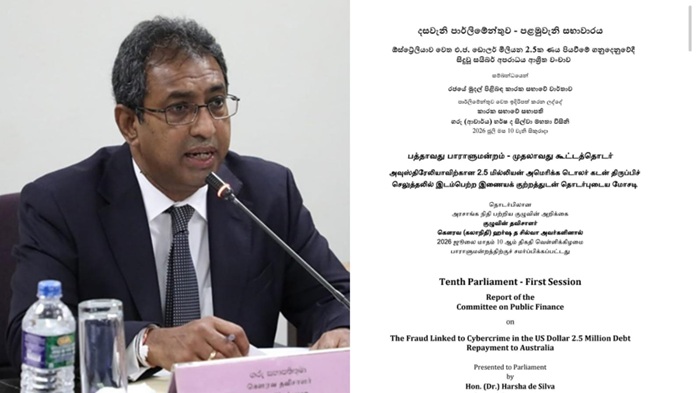
COPF final report on USD 2.5 mn cyber fraud recommends action against all responsible The US$2.5 million loss incurred during Sri Lanka’s foreign debt repayment to Australia was a clear case of a cybercrime and theft, Committee on Public Finance (COPF) Chairman Dr. Harsha de Sil…
COPF final report on USD 2.5 mn cyber fraud recommends action against all responsible The US$2.5 million loss incurred during Sri Lanka’s foreign debt repayment to Australia was a clear case of a cybercrime and theft, Committee on Public Finance (COPF) Chairman Dr. Harsha de Silva told Parliament yesterday. Presenting the COPF final report on the cyber fraud, Dr. de Silva said the incident amounted to a serious financial crime and called for a comprehensive investigation, by law enforcement authorities, to identify and prosecute all those responsible. The report revealed serious governance, procedural and operational failures that enabled the fraudulent transfer of public funds, while recommending sweeping reforms to strengthen cybersecurity, financial controls and public debt management systems. According to the report, officials of the Treasury and the Central Bank bore responsibility for governance lapses that contributed to the failures. It also highlighted the fact that the Ministry of Finance was operating an outdated Microsoft Exchange Server after security support had ended, while basic safeguards, such as multi-factor authentication, had not been implemented. The COPF said suspicious payment instructions linked to debt repayments involving India, the United Kingdom, Germany and Belgium had also been detected, preventing further losses. However, the US$ 2.5 million fraud materialised only in the repayment transaction involving Australia. The report has noted that officials had failed to verify lender email domains, relied on unverified email communications and lacked adequate internal controls, allowing the fraud to continue for months. Although the investigation uncovered system-wide weaknesses across several institutions, only four mid-level Finance Ministry officials had been suspended so far, the report said. The COPF has recommended a special audit of the foreign debt repayment process, strengthened cybersecurity measures across state institutions, updated financial regulations and improvements to public debt management systems. by Saman Indrajith