

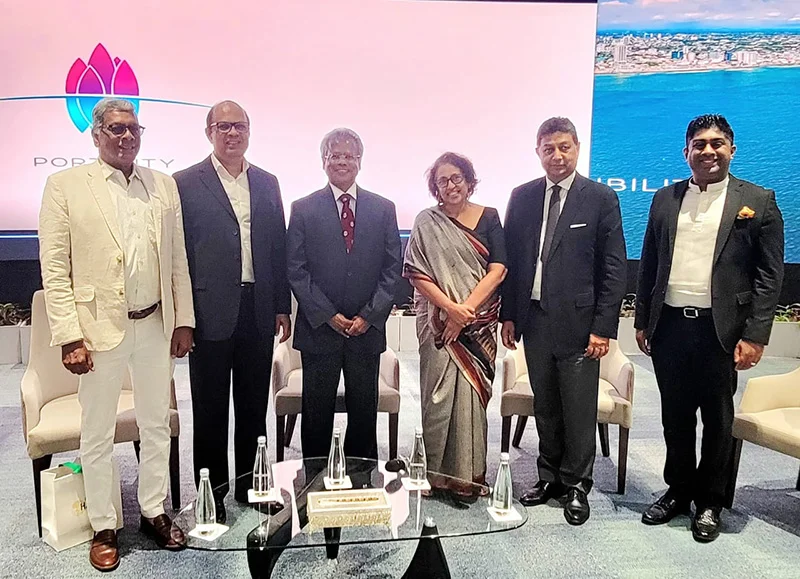
Sri Lanka must urgently strengthen policy consistency, accelerate investment reforms and fully leverage Colombo Port City as a global financial and services hub if it is to emerge as South Asia’s premier destination for foreign direct investment (FDI), business leaders and polic…
Sri Lanka must urgently strengthen policy consistency, accelerate investment reforms and fully leverage Colombo Port City as a global financial and services hub if it is to emerge as South Asia’s premier destination for foreign direct investment (FDI), business leaders and policymakers said at a high-level Public Relations Association of Sri Lanka (PRASL) forum on Monday. The discussion, themed “Taking Sri Lanka to the World,” followed an address by internationally renowned scholar Prof. Patrick Mendis, who called for a foreign policy anchored in Sri Lanka’s own identity under what he termed the “Mahaweli Doctrine.” Delivering the keynote business perspective, Colombo Port City Economic Commission chairman, President’s Counsel Harsha Amarasekara described the Port City as Sri Lanka’s largest public-private partnership and one of the country’s most significant economic transformation projects. He stressed that unlike many large infrastructure developments, the Port City had not added a single dollar to Sri Lanka’s sovereign debt, with ownership of the reclaimed land remaining entirely with the government of Sri Lanka. “The Port City is designed to compete globally in high-value services, finance, technology, tourism and innovation. It is not another industrial zone—it is a gateway connecting Sri Lanka to international markets, Amarasekara said. He said that nine land parcels had already been leased, five major projects were under construction and several additional investments were expected before the end of the year. The Port City, operating as a Special Economic Zone with transactions permitted in 14 foreign currencies, is targeting multinational corporations seeking regional headquarters, Global Capability Centres (GCCs) and innovation hubs. Amarasekara said the project’s greatest long-term value would be knowledge transfer, international expertise and high-quality employment opportunities for Sri Lankan professionals. Former Board of Investment chairman Arjuna Herath warned that Sri Lanka risked losing its long-standing competitive advantage unless it rapidly upgraded its logistics and investment ecosystem. He noted that nearly 80 percent of Colombo Port’s business depended on transshipment, with India accounting for almost half that volume while aggressively expanding its own port capacity. “If Sri Lanka fails to invest and improve efficiency, competitors will overtake us, Herath cautioned. He argued that attracting FDI was no longer simply about offering incentives but about creating a predictable business environment built on policy consistency, regulatory certainty, efficient institutions and investor confidence. Herath also highlighted Sri Lanka’s global strengths in apparel manufacturing, tyre exports and logistics, saying these industries demonstrated the country’s ability to compete internationally. International investment strategist Lakshan Madurasinghe, Chief Executive Officer of SolutionsGround (Pvt.) Ltd and former president of the American Chamber of Commerce in Sri Lanka, said Sri Lanka must fundamentally rethink the way it markets itself to global investors. While welcoming the country’s ambitious investment targets, he noted that actual inflows remained well below expectations. “The first investment is important. The second, third and fourth investments are what truly measure investor confidence, he said. Madurasinghe proposed a three-point framework—Positioning, Showing Up and Disruption (PSD)—to reposition Sri Lanka in the global investment marketplace. He called for a single national investment brand backed by the President, government institutions, overseas missions, the private sector and the Sri Lankan diaspora. “Every stakeholder must communicate one consistent message to the world. Investors must clearly understand why Sri Lanka is different and why they should choose us, he said. He also urged authorities to improve investor facilitation, strengthen aftercare services and pursue innovative investment channels, including family offices, strategic partnerships and non-traditional FDI sources. The forum concluded that Sri Lanka possesses significant structural advantages—including its strategic location, skilled workforce and expanding Port City—but these strengths must be supported by consistent policies, transparent governance and coordinated national promotion if the country is to achieve its ambition of becoming a leading regional investment, financial and services hub.
By Ifham Nizam