Golden Globe-winning actress Rosamund Pike visited Sri Lanka to support Mines Advisory Group's work, coinciding with the clearance of one million landmines since the 2009 end of conflict. The milestone reflects a major post-war reconstruction initiative, though questions remain about proper attribution of the…
British actress Rosamund Pike recently visited northern Sri Lanka's minefields in Mannar and Mullaitivu as an ambassador for Mines Advisory Group (MAG), marking the clearance of one million landmines since the conclusion of the conflict with the LTTE in May 2009. The visit, supported by the British High Commission, highlighted Sri Lanka's progress toward becoming landmine-free and underscored international recognition of the country's mine-action efforts.
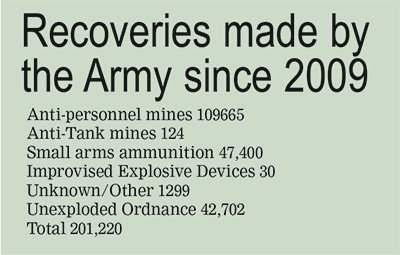
Following the war's end, Sri Lanka faced the dual challenge of rehabilitating approximately 12,000 surrendered LTTE combatants and clearing vast areas contaminated with mines and unexploded ordnance. Under the leadership of Lt. Gen. Jagath Jayasuriya, who succeeded war-winning Army Commander Sarath Fonseka in 2009, these operations proceeded methodically with international backing. Multiple organisations participated in clearance efforts, including the Army Corps of Engineers, DASH, HALO Trust, MAG, and several others. According to the source material, the Army cleared more than half of all recovered mines during this period, representing the largest share of the overall effort.
While the achievement has been internationally acknowledged, including by UN representatives who praised Sri Lanka's demining progress in 2012, questions have been raised about the proper attribution of credit. Pike declared that MAG and other organisations cleared the one million mines, though the source notes that the British High Commission's official statement notably omitted specific mention of the Army's substantial contribution to the operation.
Mine contamination stemmed from decades of conflict, with various parties deploying mines extensively. Despite successive predictions of completion, clearance operations continue to the present day under the current NPP government. Approximately 90 percent of contaminated land has been cleared, with an estimated 21 square kilometres remaining, roughly equivalent to half of Colombo's area. The successful mine clearance, combined with rehabilitation of ex-combatants, has been described as fundamental to post-war reconciliation efforts in the country.