European Commission President Ursula von der Leyen has urged stronger coordinated border security measures following a major migrant influx into Spanish Ceuta, which left dozens dead and triggered tensions between EU member states.
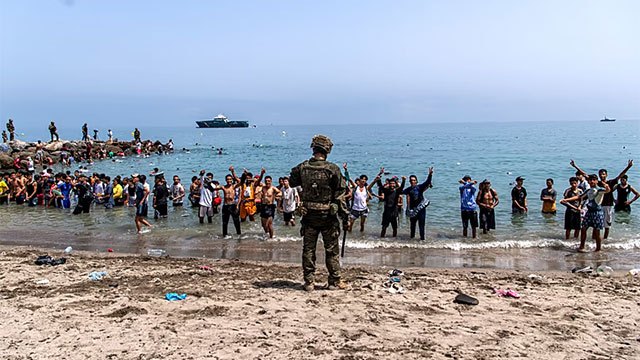
The European Commission has called for unified action on border protection after tens of thousands of migrants crossed from Morocco into the Spanish exclave of Ceuta last week. According to Spain's estimates, approximately 69,500 migrants have now returned to Morocco, surpassing initial projections of 50,000. The incident resulted in at least 72 deaths on the Spanish side and 11 on the Moroccan side, prompting urgent diplomatic responses across the bloc.
The crisis has created fissures within the European Union, with several member states taking unilateral action. Italy temporarily suspended the Schengen agreement with Spain over the incident, a move supported by Finland and Denmark. Czech Prime Minister Andrej Babiš called for a temporary suspension of Spain's Schengen membership altogether. Spanish Prime Minister Pedro Sánchez responded strongly, noting that Ceuta falls outside the Schengen area and criticizing some European governments for what he characterized as prejudice-driven responses rather than expressions of solidarity.
Von der Leyen praised Sánchez's "swift handling" of the crisis in correspondence with the Spanish leader, but emphasized that border protection represents a shared European responsibility. She outlined five priority areas requiring coordinated EU effort: preventing irregular migration through partnerships with third countries, reinforcing external borders, establishing early warning systems, dismantling smuggling networks, and improving return procedures. The Commission will host emergency talks among EU interior ministers via video conference on Tuesday to discuss the incident's lessons.
Spain's Interior Minister Fernando Grande-Marlaska reported that conditions had largely stabilized by Saturday, with authorities developing an inflatable water barrier to prevent future unauthorized maritime crossings. Spanish officials have also blamed migrant traffickers for exploiting a recent Supreme Court decision that restricted the government's ability to immediately deport sea arrivals.