From the Pathfinder Collection Published in Colombo in 1954, J. A. R. Grenier’s Tales of Fish and People of the Ceylon Estuary is a small masterpiece: an angling memoir rich in natural history, practical fishing knowledge and tender observation of the fishing communities whose l…
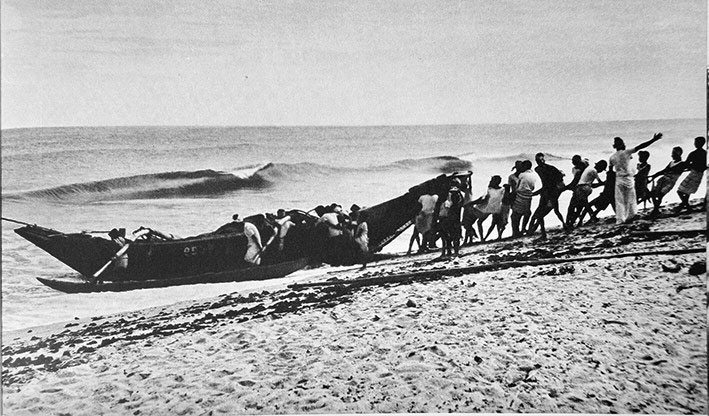
From the Pathfinder Collection Published in Colombo in 1954, J. A. R. Grenier’s Tales of Fish and People of the Ceylon Estuary is a small masterpiece: an angling memoir rich in natural history, practical fishing knowledge and tender observation of the fishing communities whose lives were bound to the sea. During the Covid lockdowns, my husband’s uncle Nimal Jayawardena began sorting through his extensive collection of books on wildlife, natural history, fishing and hunting. Boxes arrived at our house in batches. Unpacking, reading and cataloguing the books brought welcome pleasure to days otherwise marked by uncertainty, isolation and restrictions on movement. Fishermen hauling a fishing catamaran ashore after returning through the surf. Photograph by Reg Van Cuylenburg from Image of An Island – A Portrait of Ceylon (1962). Pathfinder Collection “What Will the Day Bring?” Canoe beside a tranquil estuary. Photograph by Lionel Wendt from Lionel Wendt’s Ceylon (1950). Pathfinder Collection In one of the boxes, I noticed a slim volume in a plain white dust jacket. Spartan in appearance, its only adornment was a small circular medallion showing two fish swimming in a ring around a rocky estuarine scene. The design was rendered largely in black and white, with a muted greenish-blue wash. At its centre appeared a title that promised far more than the modest artwork: Tales of Fish and People of the Ceylon Estuary. The cover did not even bear the author’s name. Inscription by J. A. R. Grenier to Nimal Jayawardena, dated 29 July 1975, with Jayawardena’s signature opposite. Pathfinder Collection. Author’s photograph Detail from the dust jacket of Tales of Fish and People of the Ceylon Estuary (Colombo, 1954), showing the distinctive fish medallion. Pathfinder Collection. Author’s photograph Out of curiosity, I opened this unassuming book and began to read. Within its weathered pages, a succession of worlds began to unfold: that of the recreational angler, for whom fishing was an absorbing passion; the natural world of Ceylon’s estuaries and their fish; the practical world of tackle, bait and technique; and, finally, the world of the fisherfolk, whose lives depended upon an intimate knowledge of the waters. Portrait of a fisherman. Photograph by Reg Van Cuylenburg from Image of An Island – A Portrait of Ceylon (1962). Pathfinder Collection. At only 155 pages, the book is divided into two parts: “Fish,” devoted to the angler, the estuary and the practical knowledge of fishing; and “The People,” in which Grenier turns to the fisherfolk themselves. The mystery of the angler Grenier begins with a question that must have been put to anglers in every generation: why devote so much time, money and effort to an occupation involving discomfort, uncertainty and frequent failure? His book is, among other things, an extended answer to that question. In this, he belongs to a centuries-old angling tradition, familiar from Izaak Walton’s The Compleat Angler, in which fishing is valued not merely for the catch but for the fellowship it creates and the intimacy with nature it permits. Grenier gives that tradition a distinctly Ceylonese expression. For him, fishing satisfies the gambling instinct: every cast holds possibility, and every expedition begins with hope. The appeal also lies in escape. The estuary is usually remote: there, Grenier writes, the river, “tired of being harassed by humanity along its banks, seeks solitude where it meets the ocean.” Grenier describes the principal fish of the estuary and deep sea, their habits, feeding patterns and preferred habitats, observing how tide, season and weather shape their movements. He also preserves a detailed practical record of fishing: tackle, baits, traditional nets and fishing methods—knowledge accumulated through years of experiment, observation and conversation. His discussion of angling is often enlivened by the companionship, banter and minor disputes of his fellow anglers. Grenier recalls an episode from A. H. Pertwee’s Ceylon Marine and Estuary Fishing. Notes on a Neglected Pastime, first published as a series of articles in The Times of Ceylon before appearing as a booklet in 1907. To convince doubters of the strength of Ringall bamboo rods, Pertwee staged a “Man versus Fish Competition” at the Calcutta swimming baths. The “fish” was Mr Mason, a powerful swimmer weighing more than ten stone—whom I cannot help imagining with a luxuriant handlebar moustache and a striped bathing costume. Harnessed to the line and given thirty feet of slack, he managed only seventy feet before Pertwee reeled him in foot by foot and finally “gaffed” him with a billiard cue. From fish to people Part Two, simply titled “The People,” is more than a change of subject; it alters the meaning of much that has come before. Grenier opens by confronting the stigma attached at that time to Ceylon’s coastal fishing communities. Those who earn their living from the sea, he observes, are often judged by people who know little of the skill and endurance their work demands, or of the dangers they face. However sympathetic, the “land-encumbered” observer, as Grenier puts it, can never fully comprehend the rigours and terrors of the sea without having faced them. The introductory chapter, titled “PRO” in capitals and quotation marks, makes Grenier’s regard for the fishermen unmistakable. They are the true professionals: men he came to admire and respect, and from whom he learned lessons extending far beyond fishing. For the working fisherman, the sea governs every aspect of life. It provides his livelihood, but may also threaten his boat and his life. Danger, hardship and uncertainty are enduring conditions of his world. The sports angler by contrast chooses temporary discomfort and may return empty-handed but to a secure bed and meal. Such conditions also help explain the fishermen’s reserve towards recreational anglers, whom they regard as outsiders whose inexperience may hinder the work and even jeopardise a catch. Grenier observes that a newcomer is fortunate if accepted within five years. Some of his happiest moments come when fishermen such as Jemma of the Kalu Ganga, Anthony of Negombo or Manuel of Mannar disclose a favoured fishing ground or allow him to join them in their boats. Yet fishing can also produce a camaraderie capable of crossing barriers firmly maintained on land. Grenier’s acceptance is never assumed, but gradually earned through patience, shared experience and respect for the fishermen’s knowledge. An invitation into a boat or the disclosure of a closely guarded fishing ground signifies far more than access to better sport. It marks his admission into a fraternity. From there, Grenier opens a window onto the fishermen and their communities through a succession of miniature biographies. The “PROS” There is Jemma, whom he calls the “King of estuary fishermen of Ceylon.” For thirty years he has fished at the mouth of the Kalu Ganga and knows every rock, obstruction and hidden danger in the estuary. So accustomed is he to sitting in his small canoe that, even on land, his legs creep beneath him into the same position when he becomes absorbed in conversation. His tackle is modest but meticulously made. Grenier’s respect for his skill deepens when one of his seemingly fragile handmade lines lands a skate weighing some twenty pounds. From Mannar comes Soosai, the shark hunter, whom Grenier describes as a “bronzed miracle of a man with limbs like jungle trees and shoulders as thick as a Dutch wall.” He lives amid the bones of his quarry. Bemiya prefers the company of fish and animals to that of people and speaks only when necessary, yet has lovely names of his own for the fish he catches. His gift lies not so much in fishing with rod and line as in diving. His large, “plate-like” hands and long, double-jointed fingers seem made for work beneath the surface, where he moves with an ease he is denied on land. Bemiya later disappears during a dangerous attempt to subdue a shark caught by his fellow fishermen. Grenier’s brief farewell to him is among the most affecting passages in the book. The final and perhaps most powerful portrait is that of Anthony, the wise and kindly fisherman of Negombo who takes Grenier under his wing. Anthony teaches him not only how to fish, but also the fisherman’s code. Behind his patience and wisdom lies a history of personal loss. The book closes with his account of the storm in which he lost his son. Boats remain at sea while the people on shore watch the horizon with the quiet dread born of bitter experience. Through Anthony’s recollection, Grenier evokes an entire village overtaken by grief, its cries of mourning rising against the gale and the breaking surf. Anthony bears his loss with a sad fatalism. The sea, he tells Grenier, “makes us and breaks us.” A society in transition J. A. R. Grenier—known as Ronald—was born in Ceylon in 1912. The world he evokes is that of late colonial and early post-independence Ceylon: government service, clubs, sporting friendships, coastal journeys and long-established personal networks, brought through fishing into close contact with communities bound by occupation, poverty and dependence upon the sea. Moved by the book, I wanted to learn more about its author. My search led me to the website of his son, David Grenier, and to the life that lay behind its pages. By the late 1950s, Grenier had concluded that his children’s prospects in Ceylon were uncertain. In 1959, his fourteen-year-old son David left for Australia with several family members, including his grandmother and aunts. Grenier followed three years later, in 1962. The decision was practical and paternal, but came at great personal cost. According to David, his father knew before leaving that he would not be happy in the West and would dearly miss the ocean, the fish and the fishing people of Ceylon. I had scarcely read those words before thinking, “he will never be happy there.” A few paragraphs later, David wrote that his father was never the same after the move. Read with that knowledge, the book becomes not merely an account of fish and fisherfolk, but also a record of a landscape, a body of knowledge, and a way of life from which Grenier was soon to be separated. The story of our copy When I returned to our copy while preparing this article, I noticed that it bore an inscription by Grenier dated 29 July 1975. Puzzled, since I knew he had emigrated to Australia more than a decade earlier, I telephoned my husband’s uncle Nimal to ask about its circumstances. Nimal recalled that Grenier had returned to Sri Lanka that year for a fishing journey “down memory lane” along the East Coast with their mutual friend Frank Kelly, who had also migrated to Australia. In his younger days, Nimal had been an avid angler, deep-sea fisherman and sportsman who knew the eastern coastline and its jungles particularly well. Frank called at his house to borrow camping equipment for the expedition, and Grenier accompanied him. By coincidence, Nimal was reading Tales of Fish and People of the Ceylon Estuary at the time. He brought the book downstairs and asked Grenier to sign it. The three men spent some time reminiscing about earlier days of fishing before Grenier and Kelly continued on their journey. Nimal also knew Willie Obeysekera and Peter Jayawardena, fellow anglers whom Grenier thanks in the acknowledgements. After retiring, Peter worked as a guide for one of the family companies, based in Inginiyagala. These connections place the book once again among the friendships and shared experiences from which it emerged. The inscription transforms our copy into a record of Grenier’s return—to waters, friendships and memories that had endured the years abroad. Grenier in Australia In later life, Grenier developed a rare and incurable illness that severely affected his health and wellbeing. He died in Queensland in 1988, aged seventy-five. When I learnt of Grenier’s death, my thoughts returned to the hope he had once expressed for Bemiya: “I hope there are fish in the place he has gone to, for without them, he, like you and I, will never be happy.” David later worked to preserve his father’s literary legacy, personally publishing Isle of Eden and Isle of Eden Revisited. A forgotten Sri Lankan classic Grenier’s work defies easy classification. It is a rare conjunction of fishing manual, angling memoir, natural history and social record. Within little more than 150 pages, he preserves an extraordinary body of knowledge about Ceylon’s estuaries: their fish, habitats, fishing methods, language and communities. It is, in effect, a compact cultural archive written in the form of an angling memoir, distinguished throughout by tenderness, restraint and quiet humanity. Its appeal extends far beyond anglers. More than seventy years after its publication, there is still nothing quite like it. The book deserves to be read again.