

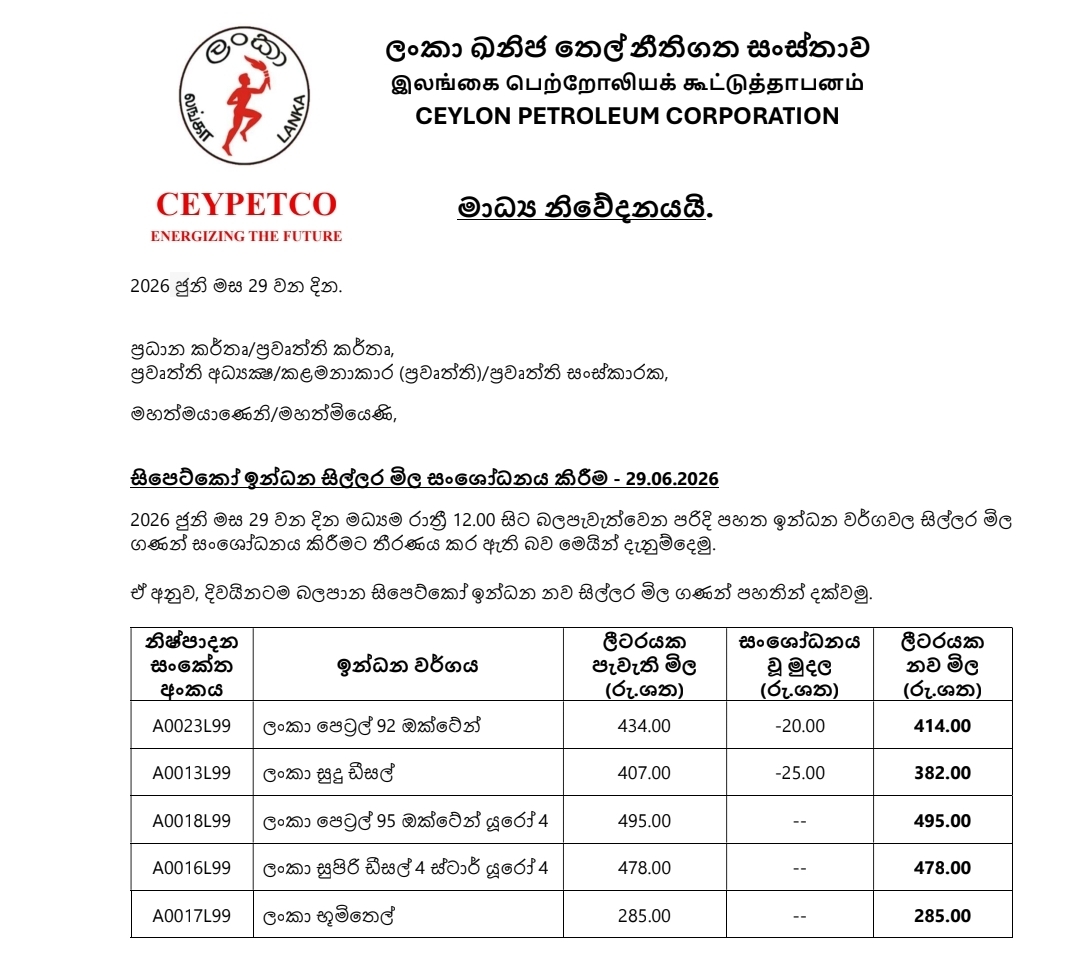
Share Tweet Wednesday 1st July, 2026 The Ceylon Petroleum Corporation (CPC) has reduced the prices of petrol 92 Octane and auto diesel marginally by Rs. 20 per litre and Rs. 25 per litre, respectively, though global oil prices are hovering near USD 70 (WTI) to USD 73 (Brent) per…
Share
Tweet
Wednesday 1st July, 2026
The Ceylon Petroleum Corporation (CPC) has reduced the prices of petrol 92 Octane and auto diesel marginally by Rs. 20 per litre and Rs. 25 per litre, respectively, though global oil prices are hovering near USD 70 (WTI) to USD 73 (Brent) per barrel almost at the pre-Iran war level. Regular petrol and auto diesel are now priced at Rs. 414 per litre and Rs 382 per litre, respectively. Sri Lanka’s oil pricing follows a rockets-and-feathers pattern rather than reflecting actual costs. The JVP-NPP government is accused of behaving like some Pettah wholesalers notorious for price gouging. Former Minister of Power and Energy Champika Ranawaka has urged the government to make public the fuel pricing formula and explain how fuel prices are worked out. Other Opposition politicians ought to join Ranawaka in pressuring the government to ensure transparency in the fuel pricing process. Ranawaka has said that according to his calculations, petrol and diesel now cost the government Rs. 220 per litre and Rs. 235-240 per litre, respectively. He has accused the government of maintaining very high mark-ups and exploiting the public. Sticky petroleum prices are not the only problem troubling fuel consumers. Fuel quality issues also cause serious concerns to them. They wonder whether fuel is clean and stable and whether they get their money’s worth at the pump. Most of them complain of a drop in fuel efficiency, rough idling, jerking and poor acceleration. Their concerns cannot be dismissed as baseless. There have been numerous instances of fuel contamination due to factors such as water ingress, sediment in underground tanks, improper handling at filling stations and even adulteration of fuel. In a country where shiploads of substandard coal have been imported with impunity, and costly diesel is burnt to meet a generation shortfall at the coal-fired power plant, with additional costs being passed on to the public, anything is possible. Most of all, the CPC has a history of selling low-quality fuel. One may recall that a special audit, conducted by the Auditor General’s Department, on the procurement of petroleum products by the CPC from 01 June 2011 to 30 June 2012, revealed that gasoline 90 Octane had been purchased at the 92 Octane price, without bargaining or negotiating with suppliers at the bid evaluation stage of the procurement process, to obtain a recommendation on the premium of that product; low quality gasoline (lower than 90 Octane) produced at the refinery of the CPC had been mixed with imported gasoline 92 Octane and that blended product had been distributed all over the country during 2011. The then Petroleum Minister Susil Premjayantha claimed that petrol may have been mixed with rainwater. But the country was experiencing a drought at that time! The present-day ministers also have earned notoriety for making such absurd claims and insulting the intelligence of the public. In 2019, the National Movement for Consumer Rights Protection alleged that the fuel sold as petrol 92 Octane actually had an octane rating of about 90.5. Subsequent laboratory analyses supported that claim. Last week, we quoted SJB trade unionist and former CPC employee, Palitha Ananda, as having claimed that the CPC refinery was unable to produce petrol with 92 Octane rating by using American crude WTI, and an experiment to produce petrol 92 Octane by using UAE’s Murban crude and WTI had been in vain. Fuel consumers are in a dilemma. They cannot rely on forecourt brands; it is not advisable to assume that one brand is inherently superior, for fuel is said to pass through the same common-user storage and quality-control system. Petroleum sector experts inform us that fuel is not meaningfully traceable by brand at the pump. It is not possible for ordinary people to have fuel tested, as is obvious, and they have to rely solely on quality assurances given by the CPC, which has tarnished its reputation. It is like asking a suspect to investigate himself.
Editorial Dengue on the rise
Published 1 day agoon 2026/06/30
Tuesday 30th June, 2026
Dengue cases continue to climb despite a countywide campaign to bring them down. The number of dengue patients has exceeded 53,000 so far this year, and 31 of them have already died. The Western Province has recorded the highest dengue case burden (27,833), accounting for about 52.36% of the national tally, with more than 124 MOH (Medical Officer of Health) areas designated as high-risk zones. Health authorities have expressed fear that unless the high incidence of dengue is brought under control urgently, the hospital network may be overwhelmed. Health authorities are reported to have found that 80% of mosquito breeding sites, identified across the country, are located in public places. About 42% of schools, inspected so far, have been found to have mosquito breeding places. Mosquito larvae density in schools surged to 63% last month, an increase from 23% recorded in April. Mosquito larvae density in government institutions is 28%. Religious places and factories have recorded larvae densities of 24% and 37%, respectively. This is a very serious situation, yet the public seems unconcerned. Health officials are in overdrive to control the spread of dengue. They have instituted legal action against the individuals who have failed to keep their houses, gardens, factories and business places free from mosquito breeding sites and threatened to prosecute the heads of the state institutions where mosquito larvae have been found. The geographical spread of the dengue burden has made the task of fighting the disease even more challenging, stretching the resources of the health authorities thin. The Health Ministry has stated that the incidence of dengue is alarmingly high in Colombo, Kalutara, Gampaha, Matara, Galle, Hambantota, Kandy, Matale, Badulla, Batticaloa, Kurunegala, Puttalam, Ratnapura and Kegalle districts. The task of eradicating dengue or other such diseases must not be left entirely to the health authorities, and the public has a pivotal role to play in fighting them. Active public participation in dengue eradication is half the battle in making the country safe. Political battles must not be fought over epidemics. Sadly, the Opposition has been hauling the government over the coals for the high incidence of dengue. The JVP did likewise while out of power; its leaders thundered in Parliament, condemning previous governments for their failure to control dengue. These parties ought to help health officials fight dengue instead of waging political battles. Some political parties claim to have hundreds of thousands of members. If so, why don’t they ask their ranks and file to help the health workers detect and destroy mosquito breeding sites in their areas, especially in public places? These parties carry out effective door-to-door propaganda campaigns in the run-up to every election, and the question is why they cannot come out in their numbers and take part in dengue control campaigns. Meanwhile, many mosquito breeding sites have been found in public spaces, and legal action must be taken against the heads of local government institutions that have failed to keep these places free from mosquito larvae. A few days ago, the media reported on several tractor trailers full of garbage parked on the roadside for days in the Kaduwela Municipal Council area. Residents have alleged that municipal workers dump garbage haphazardly, creating mosquito breeding sites in Kaduwela. These allegations must be probed. Health officials have detected mosquito breeding sites in public spaces in other local council areas as well, especially Colombo, where people are also complaining of a foul smell emanating from Beira Lake. If the existing laws do not provide for legal action against the heads of local government institutions and officials for their failure to eradicate mosquito breeding places in their areas, new legislation must be introduced to hold them accountable and make them face prosecution. Endangering the lives of ratepayers by exposing them to diseases is a serious offence that must not go unpunished.
Editorial Farmers’ protests
Published 2 days agoon 2026/06/29
Monday 29th June, 2026 Rice growers are up in arms, unable to sell their produce at fair prices. They are also demanding that fertiliser be made available at affordable prices. Instead of listening to them and making a serious effort to redress their grievances, the government has claimed that their protests are politically motivated; a deputy minister has gone to the extent of provoking protesting farmers by calling them rotgut addicts. The JVP/NPP has totally mismanaged farmers’ protests, which are likely to snowball. One may recall that it was farmers who launched the opening salvo against President Gotabaya Rajapaksa’s government, whose experiment with organic farming created a severe shortage of fertiliser. Farmers’ associations are flaying the government for having imported a large amount of rice while locally produced rice stocks remain unsold, instead of buying their produce through the Paddy Marketing Board (PMD), whose warehouses they say remain closed. The government claims that it has imported only the varieties of rice that are in short supply in the local market, but farmers are convinced otherwise. Why farmers are so resentful is understandable. They are complaining of exploitation by a cartel of rice millers, with the government doing nothing to safeguard their interests. Rice growers are struggling to make ends meet. Most of them are neck deep in debt. But the big-time rice millers are becoming richer. They are buying Rolls-Royces and even helicopters and indulging in a vulgar display of wealth while some paddy cultivators are losing their houses put up as collateral for loans. The JVP-led NPP, which promised to liberate the farming community from the clutches of powerful millers and ruthless microfinance companies and enable them to obtain bank loans without collateral, has reneged on its pledge. Successive governments have furthered the interests of big-time millers by importing rice close to the commencement of harvesting seasons, according to farmers’ associations and independent researchers. Unfortunately, the JVP-NPP government, which came to power, with the help of farmers among others, promising them the stars and the moon, stands accused of helping large-scale millers maximise their profits at the expense of both cultivators and consumers. We have written extensively about how haphazard rice imports which governments resort to, claiming to overcome rice shortages, affect the interests of the farming community. As harvesting seasons near, millers create shortages of rice. Instead of taking action to trace hoarded rice, governments readily import rice for the benefit of politicians and bureaucrats rather than anyone else. When the imported rice arrives, millers slowly release their stocks into the market bringing the prices of rice down temporarily and using that opportunity to purchase paddy for a song. The PMD, which the JVP/NPP promised to revitalise to compete with private millers, does precious little to help farmers. When locally produced rice reaches the market, the demand for imported rice decreases, as Sri Lankans prefer local rice. Eventually, the stocks of imported rice rot in government warehouses and end up as animal feed. Allegations that rice is used as a primary brewing ingredient by beer manufactures have sparked a major controversy and economic concerns. Allegations also abound that influential millers delay the release of bank loans that small and medium scale millers apply for to purchase paddy so that they can buy most of the paddy at uncompetitive prices. No government has done anything about these practices detrimental to the interests of rice growers and consumers, for obvious reasons, according to researchers. Wealthy rice millers bankroll election campaigns and have politicians eating out of their hands. The incumbent government launched a programme to clear unauthorised structures in the reservations of the irrigation tanks in the North Central province. But that initiative has withered on the vine for all intents and purposes because a hotel belonging to a powerful rice miller has encroached on the reservation of a tank in Polonnaruwa. The government, like its predecessors, claims that it has to be mindful of the interests of consumers and keep the prices of rice at reasonable levels and therefore cannot meet farmers’ demand for increasing the threshold price of paddy. On the face of it, this argument does not look wholly untenable, but the fact remains that it is mostly market manipulations by powerful rice millers and high mark-ups that keep the prices of rice high. Governments do not dare address these issues.
Editorial Exchanging ginger for chillies?
Published 3 days agoon 2026/06/28
President Anura Kumara Dissanayake told Parliament on Thursday that the Prevention of Terrorism Act (PTA) would be repealed before the end of 2026. He said the PTA, introduced as a temporary measure, had lasted for 46 long years despite calls for its abolition. It is not clear from media reports on the President’s parliamentary speech how the government will set about the task of doing away with the PTA. However, one may recall that the Ministry of Justice published a proposal for a new anti-terrorism law, the Protection of the State from Terrorism Act (PSTA) in December 2025, seeking public views. If the government is allowed to replace the PTA with the proposed PSTA, it will be a textbook case of ‘exchanging ginger for chillies’, as a local saying goes. The solution will be as bad as or perhaps even worse than the problem. President Dissanayake’s admission in Parliament that the PTA is draconian and his government is planning to abolish it in response to concerns expressed by human rights campaigners and other stakeholders can be considered a self-indictment; suspects continue to be arrested and detained under the PTA and Dissanayake himself signs detention orders in his capacity as the Minister of Defence. Perhaps, the JVP leaders know better than others what it is like to be arrested and detained under the PTA. They are among those who bore the brunt of this repressive law, which has been abused by successive governments whose self-righteous leaders condemn it only when they are out of power. Their hypocrisy has resulted in the perpetuation of the PTA. Sri Lanka will incur much international opprobrium if the proposed PSTA replaces the PTA. The PSTA has already drawn heavy criticism from international human rights organisations, including the Office of the United Nations High Commissioner for Human Rights (OHCHR), which has warned that several provisions of the draft law remain inconsistent with Sri Lanka’s obligations under international human rights law. According to OHCHR’s preliminary analysis, the proposed legislation risks enabling broad criminalisation through vague definitions of terrorism, restrictions on freedom of expression, assembly and association, substantial executive powers with limited safeguards or oversight, arbitrary arrest and prolonged detention, exposure to torture, ill-treatment and enforced disappearance. OHCHR has therefore urged the government to revise the draft legislation substantially “to ensure that Sri Lanka’s counter-terrorism framework complies with international law and does not replicate the serious human rights violations associated with the PTA”. Various human rights groups, civil society organisations, political activists and the media, too, have pointed out why the PSTA cannot be accepted as an alternative to the PTA. They have echoed OHCHR’s view that the PSTA has not defined terrorism properly, and this fact runs counter to international law. An overly broad definition allows the PSTA to be misused. Having neutralised three formidable terrorist outfits, the LTTE, the JVP and the National Thowheed Jamaath, Sri Lanka needs robust anti-terror laws to protect itself against terrorism. Nothing must be left to chance. Similarly, all precautions must be taken to ensure that anti-terror laws do not contain structural flaws that can be abused to suppress civil liberties in the name of fighting terrorism. The PSTA has also been criticised for seeking to empower senior police officers to issue detention orders and authorise pre-charge detention for renewable periods of up to two months for a total of up to one year. It has been pointed out by international human rights organisations, such as Amnesty International, that the PSTA has retained untrammeled executive powers; the presidential powers are so extensive that the sole avenue for appeal against Proscription Orders lies with the Executive itself so much so that they undermine the International Covenant on Civil and Political Rights (ICCPR). The present-day leaders will do themselves a favour by abolishing the PTA, for it may be used against them when they lose power. The PTA, by its very nature, lends itself to abuse. The same is true of the proposed PSTA. Hence the pressing need to deep-six the PTA and the draft PSTA, and introduce new anti-terror laws that comply with international law.