

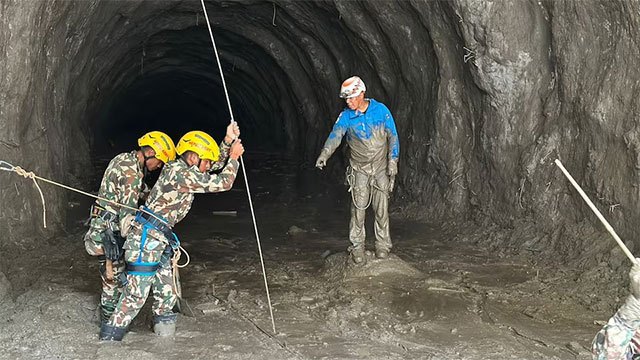
Nepali authorities believe dozens of workers trapped in an underground chamber at a hydropower plant for over a week may still be alive, with rescue teams from multiple countries working to locate survivors amid challenging conditions.
More than a week after devastating flash floods triggered by a glacial collapse swept through Nepal's hydropower facilities, officials have expressed cautious hope regarding the fate of trapped workers. A board member of the Nepal Electricity Authority stated that approximately 46 people are believed to be sheltering in a room-like structure within a tunnel at the Rasuwagadhi hydropower plant, and that rescuers are optimistic about their survival prospects given that provisions are available in the sealed space.
The disaster, which struck near Nepal's border with China, has already resulted in the rescue of 279 workers from various hydropower projects. However, at least 639 others remain unaccounted for, with many feared to be trapped in tunnel systems connected to the affected facilities. Rescue operations involve personnel from Nepal, India, and China, supported by teams from Australia and South Korea using advanced technology to navigate the treacherous conditions.
Rescue teams are focusing efforts on multiple locations where survivors may have sheltered. At the Rasuwagadhi facility, a 111-megawatt project in Rasuwa district, previous search attempts three days prior did not locate the trapped workers, prompting a renewed search effort. Similarly, at the Upper Trishuli 3A facility, rescuers are attempting to breach tunnel sections believed to contain dry shelter spaces, having encountered thick mud accumulation that delayed their earlier access.
The unprecedented natural disaster generated approximately 2.2 million tons of debris, according to preliminary estimates from the United Nations Development Programme, creating substantial obstacles to rescue operations. Officials have indicated they are deploying all available technological resources to locate survivors in the complex tunnel systems beneath the affected hydropower plants.