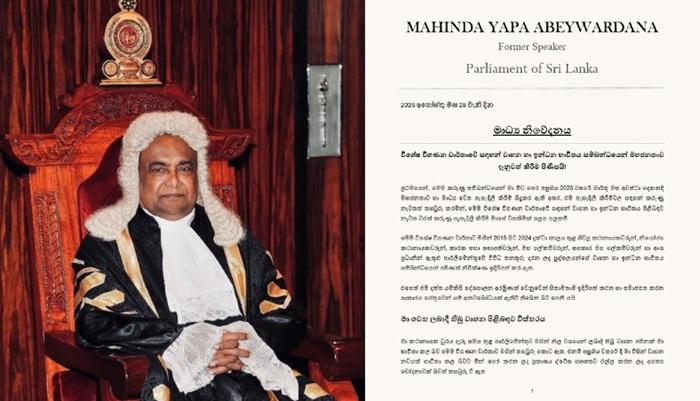
Mahinda Yapa Abeywardena has rejected findings from a special audit regarding his consumption of vehicles and fuel while serving as Speaker, characterizing the claims as distortions for political purposes.
Former Speaker Mahinda Yapa Abeywardena has issued a formal denial of allegations stemming from a special audit report examining vehicle and fuel usage by parliamentary officials between 2015 and 2024. In a statement, Abeywardena claimed that certain groups are deliberately misrepresenting audit data to mislead the public for political advantage.
Abeywardena specifically rejected claims that he operated nine vehicles during his tenure, asserting that the audit report itself confirms he used only officially allocated parliamentary vehicles. He maintained that all vehicle allocations complied with Presidential Secretariat circulars and were justified by security requirements. Following the country's political instability after July 2022, he noted that additional security personnel and protective vehicles were deployed on Defence Ministry recommendations, including a bulletproof vehicle with notably higher fuel consumption.
The former Speaker defended the elevated fuel costs by contextualizing his role as the third-ranking citizen of the country, arguing that comparisons between official convoy operations and nationwide parliamentary tours with personal vehicle usage were methodologically flawed. He emphasized that extensive island-wide travel was integral to his duties as Speaker, naturally requiring greater fuel expenditure.
Abeywardena stated he maintains no objection to legal action should genuine irregularities be evidenced, and pointed out that comprehensive vehicle records and fuel reports are held by Parliament and available for verification. He attributed some operational challenges to the severe economic and social instability experienced during 2022, which he said necessitated adjusted security and administrative arrangements. The former Speaker concluded by calling for transparency and accountability while cautioning against the weaponization of audit findings for narrow political objectives.


-852821_850x460.jpg)