

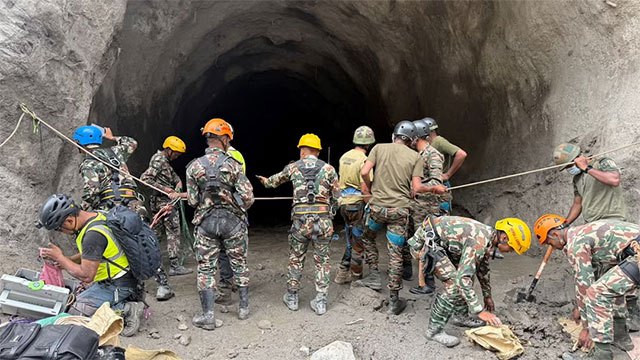
Rescue teams in Nepal are working around the clock to reach approximately 933 workers believed trapped in hydropower project tunnels following last week's glacier-triggered disaster that has killed over 900 people across Nepal and China.
Rescue operations in Nepal have entered a critical phase as teams work to extract hundreds of workers trapped in blocked hydropower tunnels following a catastrophic flood event last week. Nepalese authorities, supported by Chinese and Indian technical experts, have deployed controlled explosions, heavy excavators, and searchlights to clear massive accumulations of mud and debris blocking tunnel entrances across eleven hydropower projects in the Rasuwa and Nuwakot districts. Army spokesperson Raja Ram Basnet stated that debris obstruction presents the primary obstacle to accessing trapped workers, with three bodies recovered so far from two tunnels that have been partially cleared.
The scale of the disaster has become increasingly apparent. As of Monday, Nepali authorities confirmed 903 deaths with 4,247 people missing, including the 933 workers at hydropower sites. Chinese authorities reported 16 confirmed deaths in Gyirong County with 546 missing. An estimated 90,000 people have been affected overall, according to Red Cross calculations. International dimensions of the crisis include approximately 590 foreign nationals from 39 countries listed as missing, with China reporting 261 unaccounted foreigners in Tibet near the Nepal border.
A glacier collapse is believed to have triggered the unprecedented torrent of ice, rock, mud and debris that swept through mountain valleys. China has attributed the event to climate change effects, while state media reported that glaciers surrounding an impact crater near the collapse site remain unstable. Rescue operations have been repeatedly suspended due to adverse weather and concerns that a lake formed by the disaster along the Nepal-China border could overflow and trigger secondary flooding. Drone footage has documented multiple landslide deposits along riverbanks, increasing risks of further collapses and new lake formation.
Nepal's reliance on hydropower has expanded significantly since 2000, with projects harnessing Himalayan water resources to address domestic electricity shortages and generate export revenue through sales to India. However, tensions have emerged regarding cross-border data sharing. Two Nepali officials told Reuters that China had provided limited information on glacier and water level risks during earlier cooperative meetings, raising concerns about future preparedness capabilities. The Chinese foreign ministry countered that Beijing has continuously supplied meteorological and hydrological data to Nepal.