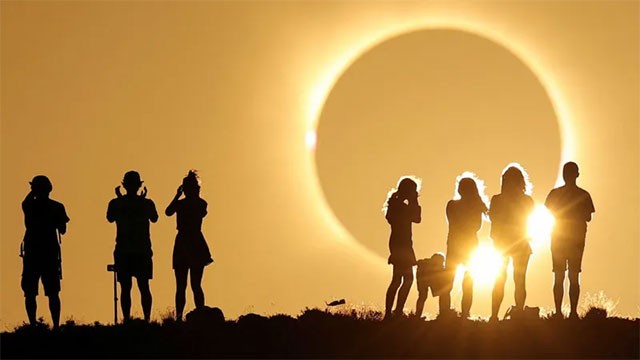
The UK and Europe experienced their most significant solar eclipse in nearly 30 years, with the UK viewing a partial eclipse while parts of Greenland, Iceland and Spain witnessed totality.
Millions of people across the UK and Europe observed a major astronomical event on Tuesday evening as the Moon passed between the Sun and Earth, creating a partial eclipse visible from the UK and a total eclipse from select locations. In the UK, the eclipse peaked shortly after 19:00 BST, with observers seeing approximately 90% of the Sun obscured by the Moon, rising to 95% in Cornwall. The partial eclipse began around 18:00 BST in northern Scotland and shortly before 18:20 on England's south coast, gradually intensifying over approximately one hour.
While the UK witnessed a partial phenomenon, the total eclipse path delivered a more dramatic spectacle to other locations. Parts of Greenland, Iceland and Spain experienced complete darkness as the Sun and Moon aligned perfectly. In northwestern Spain, totality occurred around 20:30 local time, lasting less than two minutes. Observers in these areas reported witnessing the Sun's corona—the superheated outer atmosphere visible as a red glow behind the Moon—along with pink loops of gas called prominences. A Chilean scientist present in A Coruña, Spain described the event as indescribable, noting the shared excitement among crowds witnessing the phenomenon.
Despite high demand for protective eyewear, which created shortages across shops and opticians, crowds remained undeterred. Many resourcefully used alternative methods such as colanders, cereal boxes and paper to safely observe the eclipse. This eclipse marks the UK's most dramatic since 1999, though far less intense than the country's next total eclipse, not expected until 2090. Astronomers note that total solar eclipses occur somewhere globally every 18 months, but are exceptionally rare for specific locations, happening roughly once every 400 years.