

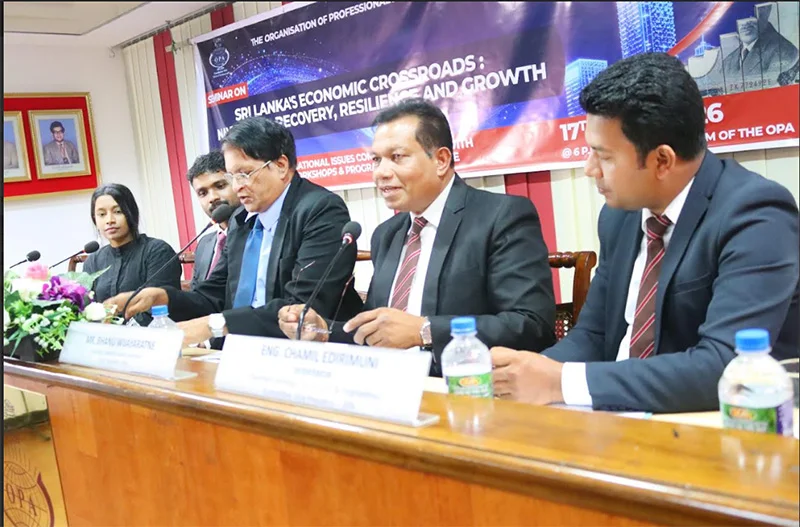
A seminar, “Sri Lanka’s Economic Crossroads: Navigating Recovery, Resilience and Growth” was recently held by the Organisation of Professional Associations of Sri Lanka (OPA) at the OPA Auditorium, bringing together economists, OPA members, and professionals from diverse fields…
A seminar, “Sri Lanka’s Economic Crossroads: Navigating Recovery, Resilience and Growth” was recently held by the Organisation of Professional Associations of Sri Lanka (OPA) at the OPA Auditorium, bringing together economists, OPA members, and professionals from diverse fields for an insightful discussion on Sri Lanka’s economic recovery and future growth prospects. The event was held under the patronage of Jayantha Gallehewa, President of the OPA, and was jointly organised by the National Issues Committee (NIC) and the Seminars, Workshops and Programmes Committee of the OPA. The event reaffirmed the organisation’s commitment to advancing professional excellence, fostering insightful intellectual engagement, facilitating interdisciplinary knowledge exchange and creating a constructive platform for informed dialogue on issues of national importance. The panel of speakers comprised Dr. Harsha Aturupane, Lead Economist and Programme Leader for Human Development at the World Bank for Sri Lanka and the Maldives; Dr. Achinthya Koswatta, Senior Lecturer in Economics at the Open University of Sri Lanka, and Anushan Kapilan, Lead Economist at Verité Research. In his welcome address, the President of the OPA emphasised that Sri Lanka was at a critical juncture in its economic recovery journey where sustained reforms, effective implementation, and collective national commitment are essential to achieving long-term stability, resilience and inclusive growth. He noted that the country had experienced one of the most severe economic crises in its history with the economy contracting by 7.8 percent in 2022 and a further 11.5 percent in 2023, resulting in significant economic and social challenges. Delivering his introductory remarks Bhanu Wijeyaratne, Vice President of the OPA and Chairman of the National Issues Committee, underscored the need to move beyond short-term economic stabilisation towards a comprehensive agenda of structural transformation. He observed that the economic crisis had revealed deep-rooted weaknesses within the economy, including persistent fiscal pressures, rising public debt, foreign exchange limitations, and insufficient diversification of the export base. He stressed that addressing these challenges through strategic reforms, institutional strengthening and long-term economic planning would be essential to establishing a more resilient and competitive economy. While acknowledging recent positive developments, including improved inflation management, tourism recovery and signs of economic stabilisation, Wijeyaratne stressed the need to advance reforms aimed at strengthening fiscal discipline, enhancing productivity, improving competitiveness, developing human capital and reinforcing governance and institutional effectiveness. He further highlighted the important role of professionals, businesses, academia and other stakeholders in contributing to evidence-based dialogue and supporting Sri Lanka’s journey towards a resilient, inclusive and sustainable economic future. Delivering the keynote presentation, Dr. Harsha Aturupane provided a comprehensive assessment of Sri Lanka’s economic prospects within the broader context of global economic transformation. He argued that Sri Lanka functioned as a small open economy whose performance is significantly influenced by developments in the global marketplace. External factors could not be controlled, and the country must strengthen its domestic capacity and resilience to respond effectively to international economic shifts, he noted. Tracing the evolution of global economic systems, Dr. Aturupane highlighted the transition from ideological divisions between state-controlled and market-oriented economies towards increasingly pragmatic approaches focused on growth, competitiveness and development. He noted that Sri Lanka’s own economic journey reflects a similar evolution, with contemporary policy debates now centred on practical solutions for sustainable economic progress. The presentation also examined the transformative impact of globalisation. Dr. Aturupane observed that global economic integration had enabled several East Asian economies, including South Korea, Singapore, Taiwan and Hong Kong, to achieve remarkable economic advancement through export-led growth strategies. Sri Lanka similarly benefited from this process through the expansion of its apparel industry and increased integration into global value chains. Turning to Sri Lanka’s recovery programme, Dr. Aturupane emphasised that the ongoing stabilisation process should be viewed as a national programme supported by the International Monetary Fund rather than solely as an IMF initiative. He observed that strong worker remittances, improved tourism earnings, enhanced government revenue mobilisation and prudent import management have contributed significantly to economic stabilisation. Despite this progress, he cautioned that rebuilding foreign exchange reserves and meeting future debt obligations remain major challenges. He underscored the need to strengthen export performance, attract investment and generate sustainable foreign exchange earnings to ensure long-term economic resilience. The discussion also focused on monetary stability, inflation management and exchange-rate policy. Dr. Aturupane stressed that maintaining price stability was fundamental to sustainable growth and household welfare, while sound monetary policy remains essential for preserving economic confidence. Looking beyond stabilisation, he argued that Sri Lanka must transition towards a broader economic transformation agenda. Sustainable growth, he noted, will depend on expanding productive capacity through investment, technological advancement, innovation, skills development and structural reforms. Among the key constraints identified was the high cost of energy, which continues to affect competitiveness and investment attractiveness. Dr. Aturupane emphasised the importance of improving efficiency and affordability within the energy sector to enhance Sri Lanka’s business environment. He further highlighted the social dimensions of the crisis, noting the rise in poverty and economic vulnerability among households. Strengthening social protection systems and ensuring inclusive growth, he argued, must remain central components of the national development agenda. Another critical challenge identified was Sri Lanka’s demographic transition. With an ageing population, outward migration and evolving labour market dynamics, the country is increasingly confronting labour shortages in several sectors. Dr. Aturupane suggested that greater automation, increased labour-force participation and strategic workforce planning would be necessary to address these emerging realities. Concluding his presentation, he emphasised the need to improve governance, strengthen institutions, enhance competitiveness and create an enabling environment for private sector investment. Sri Lanka’s future success, he noted, will depend on its ability to move decisively beyond crisis management towards a development model founded on resilience, innovation, productivity and inclusive growth. Dr. Achinthya Koswatta reiterated the importance of policy consistency and predictability in fostering investment and industrial development. She observed that frequent policy changes create uncertainty and discourage long-term investment decisions, whereas stable and coherent policy frameworks build confidence and support sustainable economic transformation. Meanwhile, Anushan Kapilan highlighted the substantial progress achieved in restoring macroeconomic stability following the recent crisis. He noted significant improvements in fiscal performance, including increased government revenue, reduced reliance on debt financing and a historically low fiscal deficit. He further observed that public debt levels are declining faster than anticipated, economic growth has exceeded expectations and inflation has been brought under control more rapidly than forecast. Nevertheless, he cautioned that the recovery remains uneven, particularly within the industrial sector and that many households have yet to experience a meaningful improvement in living standards. The seminar was expertly coordinated by Eng. Chamil Edirimuni, Vice President of the OPA and Chairman of the Seminars, Workshops and Programmes Committee, while the technical moderation and interactive discussion session were facilitated by Bhanu Wijeyaratne, Vice President of the OPA and Chairman of the National Issues Committee. The event was attended by Tisara De Silva, President-Elect of the OPA, Eng. Ravi Rupasinghe, General Secretary, Past Presidents, members of the Executive Council, representatives of the General Forum and professionals representing a wide range of disciplines. The seminar concluded with a vibrant exchange of ideas and perspectives, reaffirming the importance of evidence-based policy dialogue, institutional collaboration and collective national commitment in advancing Sri Lanka’s economic recovery, resilience and sustainable growth.