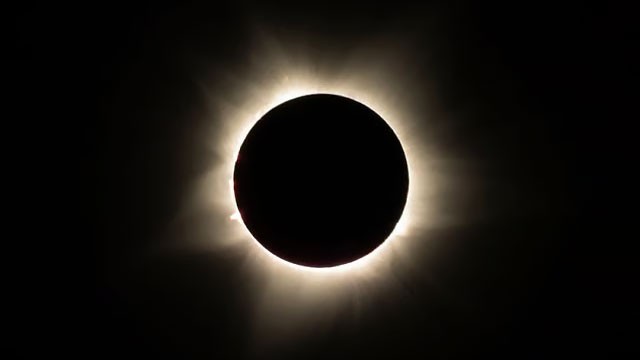
A rare total solar eclipse will occur on August 12, 2026, with its path of totality crossing Greenland, Iceland, Spain, parts of the North Atlantic and northern Russia. While no Arab nations lie directly in the path, parts of North Africa will experience significant partial coverage.
Astronomers are preparing for a major celestial event on August 12, 2026, when a total solar eclipse will be visible from select regions across the Northern Hemisphere. The Moon will pass directly between the Earth and the Sun, casting a shadow across a narrow corridor known as the path of totality, where observers will witness the complete obscuration of the Sun and its normally invisible outer atmosphere, or corona.
The eclipse's path of totality will traverse Greenland, Iceland, Spain, portions of the North Atlantic Ocean, and northern Russia. In these locations, skywatchers will experience the full phenomenon as the Moon blocks sunlight entirely. Beyond this corridor, a partial eclipse will be visible across a much wider geographic area, with the degree of coverage varying by location.
While no Arab country falls within the path of totality, North Africa is positioned to observe a particularly deep partial eclipse. Algeria is expected to see the most dramatic effect in the Arab world, with the Sun's disc obscured by up to 96 per cent in certain areas. Morocco will experience approximately 88 per cent coverage in Rabat, while Tunisia and Mauritania are forecast to see around 50 per cent and 46 per cent coverage respectively. In contrast, Egypt, Iraq, the Gulf states, the Levant region, and Libya are situated outside the observable eclipse zone and will not witness significant effects from the event.
The August 2026 eclipse is anticipated to draw millions of observers worldwide, including astronomy enthusiasts, professional photographers and eclipse chasers who will travel to optimal viewing locations along the path of totality.