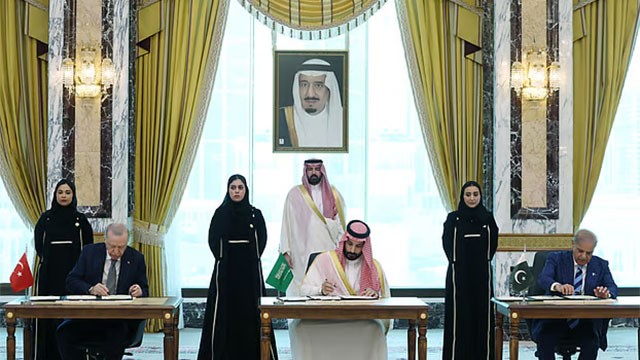
Three major Muslim-majority nations signed a collective defence agreement in Mecca on Friday, pledging mutual security commitments as regional conflicts involving Iran, Israel and various armed groups intensify across the Middle East.
Saudi Arabia, Turkey and Pakistan formalized a joint defence pact in Mecca, establishing a trilateral security framework aimed at strengthening collective deterrence against regional aggression. Under the terms of the Mecca Joint Defence Agreement, an armed attack on any one of the three signatories would be treated as an attack on all three. Turkish officials characterized the accord as defensive in nature and stated it remains open to participation by other regional countries without replacing existing bilateral arrangements.
The agreement comes amid escalating military tensions across the Middle East. Since late February, Iran and allied forces have launched missile and drone attacks against Saudi Arabia and other Gulf states, while also targeting shipping routes. The conflict has expanded to include Israeli military operations in Gaza, Lebanon and Syria, along with Iranian retaliatory strikes. The three signatory nations cite concerns over both Israeli and Iranian military postures as key motivations for the pact.
Experts emphasize the symbolic significance of the summit's location and timing. Abdulaziz Sager, chairman of the Saudi-based Gulf Research Center, noted that the gathering of three influential Muslim states demonstrates growing willingness among regional powers to coordinate security matters independently. The agreement builds upon longstanding military relationships, including decades of Pakistani training support to Saudi forces, Turkish drone sales to Riyadh, and bilateral defence cooperation.
The pact reflects each nation's distinct security position and capabilities. Saudi Arabia, home to Islam's holiest sites and a major oil exporter, has endured repeated attacks threatening its economy. Pakistan, the world's only nuclear-armed Muslim nation, brings defence industry expertise alongside troop deployments already stationed in Saudi Arabia. Turkey, possessing NATO's second-largest military, contributes significant defence manufacturing capacity. Analysts suggest Pakistan's nuclear deterrent remains focused on regional concerns rather than broader Middle Eastern conflicts.