

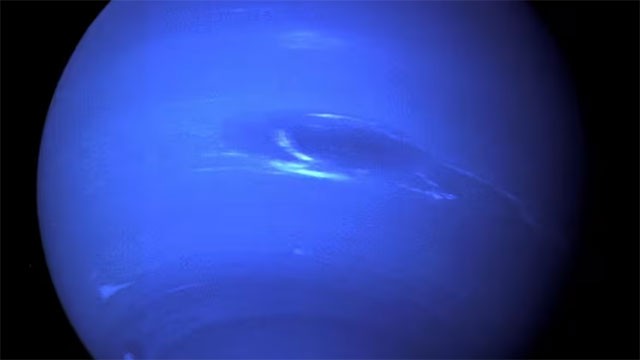
New observations from NASA's James Webb Space Telescope suggest that a Pluto-sized object captured by Neptune billions of years ago triggered a catastrophic collision that destroyed the planet's original moons, leaving behind the smaller moons and rings we observe today.
Researchers analyzing data from the James Webb Space Telescope have found evidence of a dramatic cosmic event in Neptune's distant past. The study, led by planetary scientist Ryleigh Davis from the University of California, San Diego, examined three of Neptune's inner moons — Proteus, Larissa and Galatea — along with the planet's dusty rings. The analysis detected magnesium-rich clay minerals typically found in the deep interiors of large icy worlds, such as the dwarf planet Ceres in the asteroid belt.
The presence of these clay minerals on Neptune's small moons presents a puzzle, since the moons themselves are too small and cold to have produced such minerals naturally. Davis explained that clay formation requires prolonged contact between liquid water and rock, conditions that could only have existed in the interiors of much larger ancient worlds. This discovery points to a catastrophic event that destroyed those larger moons and scattered their debris across Neptune's satellite system.
Researchers believe the culprit was Triton, Neptune's current largest moon, which they argue was originally a Kuiper Belt object captured by Neptune's gravity sometime during the solar system's chaotic early period, roughly 4.5 billion years ago. After capture, Triton's own gravitational forces destabilized Neptune's original moons, causing most to collide with each other. The current inner moons subsequently reformed from this wreckage. Triton's retrograde orbit — moving opposite to Neptune's rotation — supports the capture hypothesis, as such an orbit would be unusual for a moon that formed in place around the planet.
The findings highlight a fundamental difference between Neptune and other gas giants. Jupiter, Saturn and Uranus each possess orderly systems of large regular moons that formed alongside their planets. Neptune, by contrast, has a satellite system dominated by a single captured interloper, with Triton comprising over 99 percent of the total mass. One of Neptune's outer moons, Nereid, likely survived as the sole remnant of the original system, according to researchers.