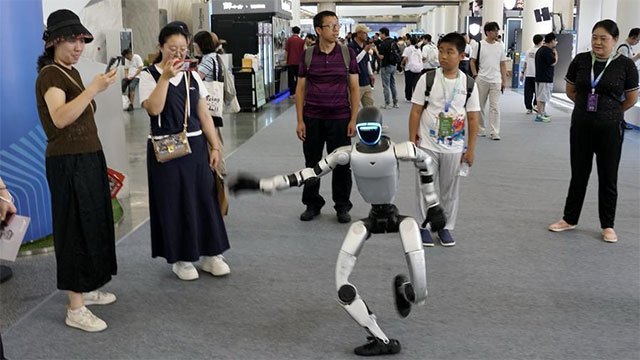
The 2026 World Robot Conference opened in Beijing this week, drawing record numbers of exhibitors and emphasizing real-world deployment of robotic technology across multiple industries.
The World Robot Conference in Beijing has opened with unprecedented scale, attracting over 300 exhibitors—a 36 percent increase from the previous year—and showcasing more than 2,000 exhibits across a roughly 50,000-square-meter space. Among the displays, over 150 products are making their global debut at the event, which operates under the theme "Human-Robot Symbiosis, Production Demand Convergence."
This year's conference marks a notable shift in focus toward practical implementation rather than merely displaying technological innovations. The exhibition space is divided into four halls, with a new dedicated zone featuring 49 central state-owned enterprises jointly presenting 12 application scenarios. The conference has also introduced a "robot consumption street" where robot chefs prepare meals and beverages on-site for attendees. Additionally, organizers are launching an initiative to provide humanoid robots, quadruped robots, and dexterous hands to innovation teams worldwide for real-world testing.
According to Xin Guobin, vice minister of industry and information technology, China's robotics sector generated revenue exceeding 300 billion yuan (approximately $44.45 billion) in 2025, with average annual growth surpassing 20 percent over the past five years. First-half 2026 revenues reached 165.5 billion yuan, representing 24.5 percent year-on-year growth. Xin emphasized that robotic technologies have become integral to economic and social development across the nation.
The conference unveiled the "Development Initiative on Intelligent Robots for the Positive and for Good," designed to coordinate international efforts in supporting the healthy expansion of the robotics industry. The opening ceremony also recognized the top innovation achievements and high-value application scenarios from central enterprises, underscoring the event's emphasis on transitioning robotics from concept to operational reality.