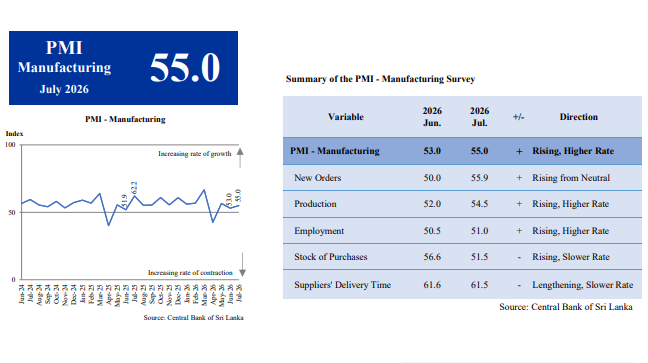
Sri Lanka's economy showed broad-based growth in July 2026, with both manufacturing and services sectors expanding amid government initiatives for reconstruction and pharmaceutical reform.
Sri Lanka's economic activity accelerated in July 2026, driven by expansions across multiple sectors. The manufacturing sector's Purchasing Managers Index reached 55.0, up from 53.0 in June, with the Central Bank noting that all sub-indices contributed positively to the improvement. The food and beverage sector led growth, particularly in new orders and production, while employment levels remained relatively stable at 51.0. However, supply-chain pressures persisted, with suppliers' delivery times continuing to lengthen.
The services sector demonstrated stronger momentum, with its PMI climbing to 61.4 compared to 58.5 the previous month. Transportation, financial, and professional services drove this expansion, supported by increased hiring and reduced staff resignations. The Central Bank attributed positive sentiment partly to expectations of increased tourist arrivals during the upcoming Kandy Esala Perahera season, though it cautioned that global uncertainties remain a downside risk.
Meanwhile, the government advanced several economic policies. The cabinet approved a new National Pharmaceutical Policy for 2026–2030 to ensure affordable and safe medicines, replacing an outdated framework from 2005. Additionally, a 200 million US dollar loan agreement with the Asian Development Bank was signed to fund post-Cyclone Ditwah reconstruction efforts over five years, including road rehabilitation, irrigation restoration, and livelihood support. In financial markets, the rupee strengthened slightly to 331.62/68 against the US dollar, while bond yields held relatively steady.
State-owned Bank of Ceylon announced plans to raise 10 billion rupees through perpetual Additional Tier 1 Capital bonds, aimed at enhancing its capital adequacy ratio. The government also approved transferring idle construction machinery and vehicles from the State Engineering Corporation to provincial councils and local authorities for infrastructure development projects.