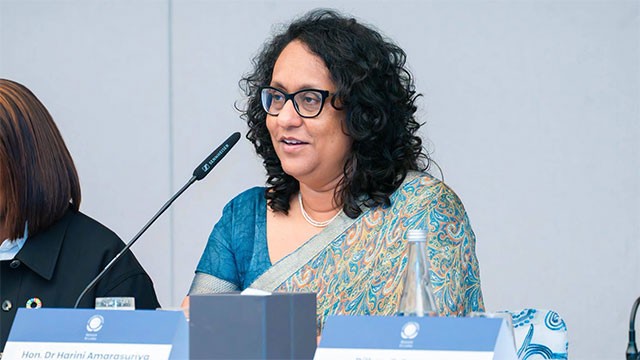
Prime Minister Harini Amarasuriya has called for transparent, long-term investments that uphold human rights and environmental standards as Sri Lanka works to achieve sustainable development goals. The appeal comes as the Asia-Pacific region faces a US$1.5 trillion annual financing gap for SDG targets.
Sri Lanka's government is actively seeking responsible foreign investment to support equitable economic growth while maintaining environmental and social standards, Prime Minister Dr. Harini Amarasuriya announced at the Asia-Pacific SDG Investment Forum in Colombo this week. The forum, organised by the United Nations Global Compact and Sri Lanka's Board of Investment, brought together business leaders, policymakers and development specialists to discuss mobilising capital for sustainable development across the region.
Addressing the challenges facing developing economies, the Prime Minister highlighted the scale of the financing crisis confronting the region. The Asia-Pacific faces an annual gap of approximately US$1.5 trillion to meet sustainable development targets, with the region at risk of missing 88% of measurable SDG objectives by 2030. She noted that while Sri Lanka's economy has stabilised following recent difficulties—recording 5% growth in 2025 with GDP reaching US$108.8 billion—the government's ambitions extend beyond headline figures.
The Prime Minister emphasised that genuine economic transformation must create employment and distribute benefits fairly across society. She outlined expectations that investors adopt responsible practices, including paying fair wages, providing training, meeting tax obligations, and protecting the environment. Greater participation by women and historically marginalised groups in economic activities was identified as a key priority. The government has introduced policy frameworks including the Central Bank's Sustainable Finance Roadmap and Green Finance Taxonomy to address climate challenges and improve financing access for small and medium enterprises.
Sanda Ojiambo, UN Global Compact CEO, underscored that the financing gap stems not from insufficient global capital but from misalignment of investment priorities. While the private sector holds approximately US$22 trillion, investment remains concentrated in areas that do not address SDG needs. She called for redirected capital toward housing, fair wages, education and clean energy, while reducing support for fossil fuels. The UN Global Compact is establishing a CFO Coalition aimed at mobilising US$10 trillion in sustainable financing by 2030 through blended-finance mechanisms.