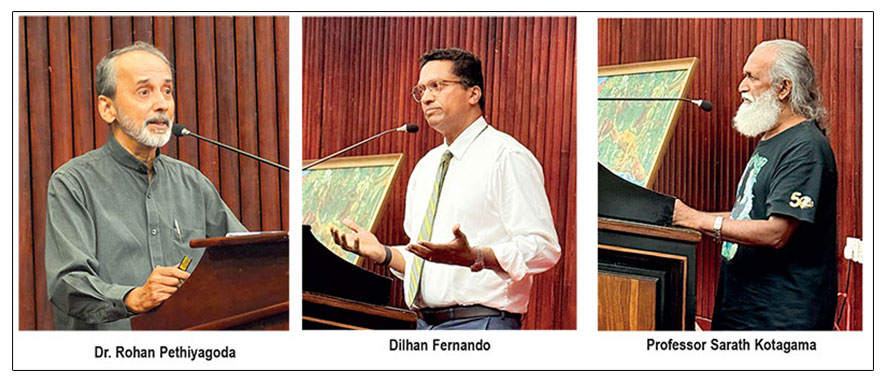
Renowned Sri Lankan naturalist Dr. Rohan Pethiyagoda unveiled his latest book at BMICH, positioning scientific curiosity as a fundamental conservation strategy. The publication aims to bridge rigorous science with public understanding through accessible storytelling.
Dr. Rohan Pethiyagoda, an internationally acclaimed taxonomist and naturalist, launched his book The Curious Naturalist at the Bandaranaike Memorial International Conference Hall on Thursday, drawing scientists, academics, conservationists, government officials and environmental advocates. The publication represents what Pethiyagoda described as potentially his final solo work, though attendees expressed reluctance to accept that prospect.
The book transforms complex scientific concepts into engaging narratives accessible to general readers, covering topics ranging from freshwater fishes and insects to evolution and ecology. Pethiyagoda emphasized that many historical scientific breakthroughs began with simple observation rather than advanced technology, citing Charles Darwin's work as an example. He called on young Sri Lankans to develop careful observation skills and critical thinking rather than accepting information uncritically.
Speakers from diverse sectors affirmed the book's importance for conservation. Director General Ranjan Marasinghe of the Department of Wildlife Conservation described it as a vital bridge between rigorous science and public understanding, noting that modern conservation debates are often shaped by fragmented information. Professor Sarath Kotagama, Sri Lanka's foremost ornithologist, praised Pethiyagoda's rare combination of intellectual curiosity and linguistic clarity. Business leaders Dilhan C. Fernando and Malik J. Fernando highlighted connections between biodiversity conservation and economic sustainability, arguing that healthy ecosystems underpin both tourism and product quality.
Throughout the evening, speakers emphasized that long-term conservation requires a scientifically informed society capable of appreciating ecological relationships. They expressed concern that climate change, habitat degradation, pollution and poorly planned development continue threatening Sri Lanka's biodiversity. The Curious Naturalist was widely recognized as a significant contribution to conservation education, with potential to reach audiences beyond traditional academic circles, particularly students and general readers.