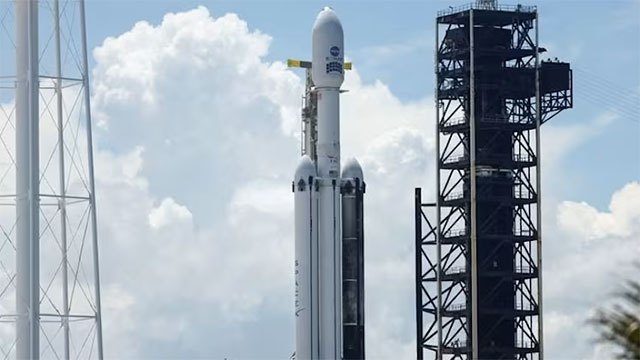
NASA successfully launched its new $4 billion Nancy Grace Roman Space Telescope from Kennedy Space Center aboard a SpaceX Falcon Heavy rocket on Sunday. The observatory will investigate dark energy, dark matter, and exoplanets while complementing existing space telescopes.
NASA's Nancy Grace Roman Space Telescope lifted off from Florida on Sunday, beginning its journey to explore fundamental questions about the cosmos. Carried aloft by a SpaceX Falcon Heavy rocket despite some weather concerns, the roughly $4 billion observatory represents a significant addition to humanity's astronomical capabilities. The telescope will travel to Lagrange Point 2, a gravitational balance point approximately one million miles from Earth, where it will conduct its five-year primary mission with potential for an additional five years of operation.
The Roman telescope is designed to complement rather than duplicate existing space observatories. While the James Webb Space Telescope functions as a powerful zoom lens probing distant cosmic objects in detail, Roman operates as a wide-angle camera, capturing panoramic views of the universe at remarkable speed. NASA officials emphasize that Roman can survey the entire Milky Way galaxy in one month—a task that would require approximately a century using the Hubble Space Telescope, which has served astronomers since 1990.
Among Roman's primary objectives is creating the most comprehensive three-dimensional map of the universe to date, covering more than two billion galaxies over more than a year of observation. This survey aims to unlock the secrets of dark energy and dark matter, which together account for approximately 95 percent of the universe's composition, while ordinary matter comprises just 5 percent. Scientists disclosed in 1998 that the universe's expansion was accelerating, with dark energy as the hypothesized driving force. Roman will also conduct extensive searches for exoplanets, potentially discovering thousands of worlds beyond our solar system and providing the first statistical census of planetary systems resembling our own.
The launch arrived nine months ahead of schedule, according to NASA. The project survived repeated funding challenges during both of President Donald Trump's administrations, with Congress consistently preserving its budget despite executive branch efforts to reduce or eliminate support.