

Sri Lanka's Cabinet of Ministers greenlit several proposals on Tuesday spanning financial regulation, infrastructure development, and judicial reform, while Treasury bill yields declined across shorter maturities.
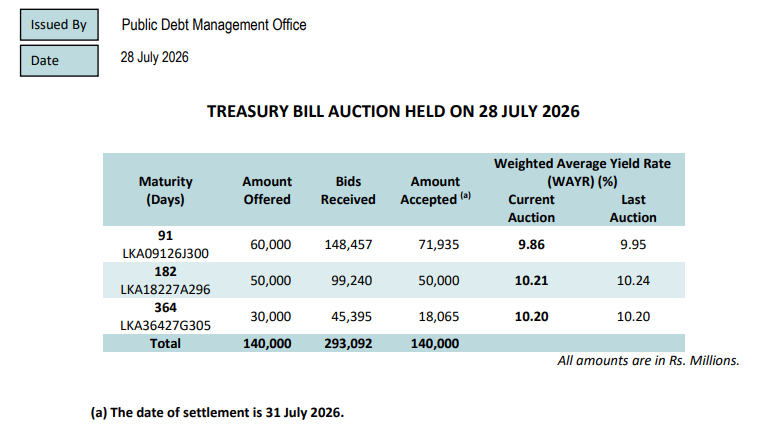
Sri Lanka's Cabinet of Ministers approved a series of significant proposals on Tuesday, with announcements covering financial markets, infrastructure, and governance matters. According to the Public Debt Management Office, Treasury bill yields decreased across shorter maturities during an auction, with all 140 billion rupees offered sold. The 3-month bill yield fell 9 basis points to 9.86 percent, while the 6-month bill declined 3 basis points to 10.21 percent. The 12-month bill remained unchanged at 10.20 percent.
In regulatory developments, the Cabinet designated the Securities and Exchange Commission as the official regulator for virtual assets and cryptocurrency trading platforms. The decision aims to bring previously unregulated offshore and peer-to-peer cryptocurrency trading channels under formal oversight through Anti-Money Laundering and Countering the Financing of Terrorism compliance requirements. Additionally, the government approved contracts valued at approximately 15 billion rupees for the first phase of the Ruwanpura Expressway Project, connecting Kahathuduwa to Ingiriya using local budgetary allocations.
The Cabinet also greenlit the establishment of a state-owned company to manage and operate the country's multimodal transport hubs, with two facilities currently operational in Makumbura and Kadawatha and two more under construction in Anuradhapura and Kandy. Separately, the government approved the disposal of accumulated scrap metal from the state-run Transport Board for 195.89 million rupees, distributing contracts among six bidders.
On judicial matters, the Cabinet approved proposals to amend the Constitution and Judicature Act to increase judges' statutory retirement age. The government stated the measure aims to retain experienced judges across all court tiers, though observers widely view it as an effort to extend the chief justice's tenure. The Bar Association of Sri Lanka has raised concerns, urging consultation with stakeholders before constitutional amendments.







-848812_850x460.jpg)
