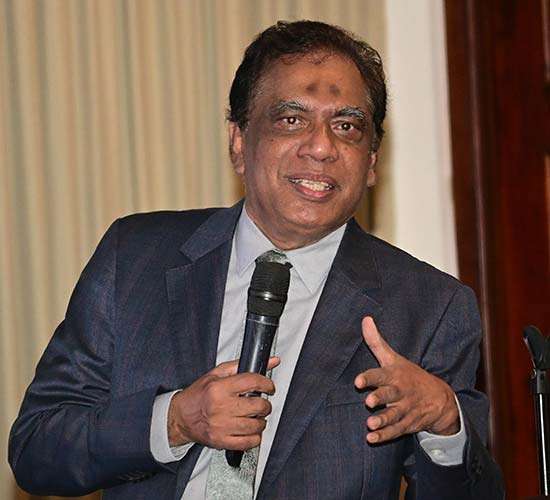
Supreme Court Justice A.H.M.D. Nawaz has outlined how Sri Lanka's amended anti-money laundering legislation significantly broadens potential criminal exposure for financial sector employees who knowingly facilitate illicit transactions.
Sri Lanka's revised anti-money laundering framework creates expanded criminal liability for bank managers and other financial institution employees who knowingly process or enable transactions involving illegal funds, according to remarks made by Supreme Court Justice A.H.M.D. Nawaz at a legal forum last week. The justice explained that bank employees who deliberately facilitate illicit money transfers could face charges of aiding and abetting money laundering, while managers who knowingly receive criminal property may themselves be prosecuted for money laundering. Justice Nawaz stressed that prosecutors must establish the accused's knowledge of wrongdoing to secure convictions.
The comments arrive as authorities investigate approximately $1 billion in alleged overseas transfers since 2023 that purported to involve imports which never materialized. Four bank officials have been remanded in connection with the probe, with investigators alleging use of forged customs documentation, breaches of Central Bank rules, and payments to bank staff for facilitating transactions. Justice Nawaz used such trade-based money laundering schemes as an illustration, describing scenarios where advance payments are sent abroad but goods never arrive.
The amended legislation moves beyond Sri Lanka's 2006 law by covering laundering activity conducted partly within and partly outside the country, as well as proceeds from foreign criminal conduct that would be unlawful if committed domestically. The framework now treats money laundering as a stand-alone offence without requiring prior prosecution of the underlying predicate crime. Additionally, unexplained funds disproportionate to legitimate income can trigger money-laundering proceedings if their origins cannot be credibly explained. Justice Nawaz described this as "a greater advance in the law."
The revised framework strengthens enforcement mechanisms, allowing police officers at Assistant Superintendent rank or above to obtain freezing orders for suspected unlawfully obtained property, with initial freezing periods of 14 days extendable through High Court application. Financial institutions and certain professionals now face mandatory reporting obligations regarding suspicious activity, with failures to report subject to penalties. Justice Nawaz noted that Sri Lanka faces an Asia/Pacific Group on Money Laundering assessment potentially scheduled for October, suggesting current enforcement challenges "leave much to be desired."