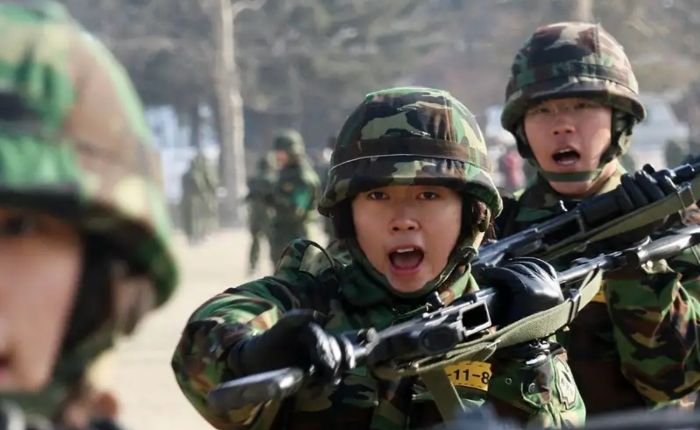
Nearly 60% of South Koreans now support requiring women to undergo mandatory military conscription, marking a significant shift in policy debate as the country grapples with a declining population and shrinking pool of male recruits.
South Korea is moving closer to extending mandatory military service to women, a historic policy shift driven by demographic pressures and evolving attitudes toward gender equality. According to a survey conducted by the Reform Institute and published on August 20, almost 60% of respondents favored changing the law to require women to serve, while just 34% opposed the measure. Support was notably higher among men, with nearly 65% in favor and over 71% support among men in their 20s and 30s. Women showed 54.5% support across all age groups.
The policy debate emerges as South Korea faces a severe recruitment crisis. The Defense Ministry reports that the number of men eligible for the mandatory 18-to-21-month service requirement dropped from 332,000 in 2019 to 257,000 in 2022, with projections showing further decline to just 120,000 by 2043. This shrinking pool of potential conscripts has intensified discussions about expanding the recruitment base ahead of planned defense reforms scheduled for autumn release.
Beyond demographic necessity, the debate reflects broader conversations about gender equality in South Korean society. Hyobin Lee, a professor at Sogang University, explained that younger men increasingly question why military service remains exclusively male when other civic opportunities have become gender-neutral. Additionally, modern warfare has shifted away from purely physical combat roles toward technology-dependent defense systems, including cyber capabilities and unmanned systems that do not require physical strength.
However, resistance persists. Some argue that women should remain excluded from frontline roles and that South Korea should instead invest in advanced military technologies such as drones. Lee also cautioned that mandating equal military service for women could prove counterproductive if broader gender equality gaps in society remain unaddressed.
-852939_850x460.jpg)
-852921_850x460.jpg)