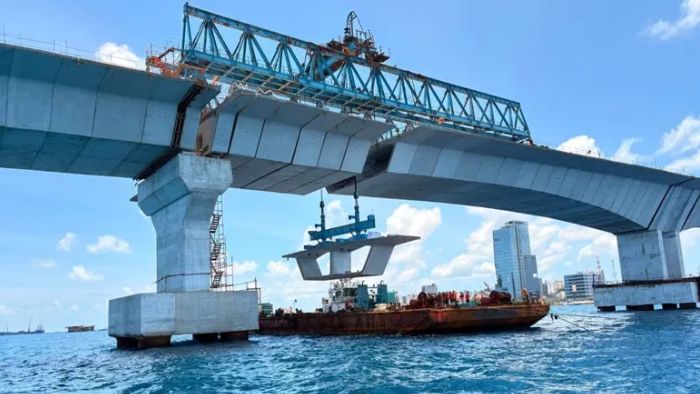
The Greater Malé Connectivity Project has achieved over 75% completion following the installation of its final bridge segment, connecting the capital with neighbouring islands in a significant step forward for this India-funded infrastructure initiative.
The Maldivian government has marked a major achievement in its largest infrastructure undertaking, with the final bridge segment of the Greater Malé Connectivity Project (GMCP) now in place. The 6.74-kilometre network of bridges, viaducts and roads is designed to link Malé with Villingili, Gulhifalhu and Thilafushi, collectively home to nearly half of the nation's population. The project has progressed to over 75% completion as of mid-2026, according to officials.
India is playing a central role in the project's development, providing $500 million in funding comprising a $100 million grant and $400 million line of credit. Indian contractor Afcons Infrastructure is managing the construction work. The infrastructure initiative was first proposed during a 2019 visit by India's External Affairs Minister and subsequently contracted in 2021. The Indian High Commission characterised the bridge installation as a significant breakthrough that brings the islands closer to seamless connectivity.
Maldivian officials across the political spectrum have welcomed the progress. Foreign Minister Iruthisham Adam credited President Dr. Muizzu's leadership for driving momentum on the project and highlighted it as a flagship example of bilateral cooperation between the two nations. Opposition leader and former Foreign Minister Dr Abdulla Shahid also praised the milestone, noting that the project was launched during his tenure and representing the strength of Maldives-India relations.
Once completed, the project is expected to address chronic congestion in densely populated Malé, where residents currently rely on boats for travel between islands. The infrastructure will improve access to industrial zones and a planned new port while supporting broader decentralisation efforts and reducing pressure on the capital's limited land resources.