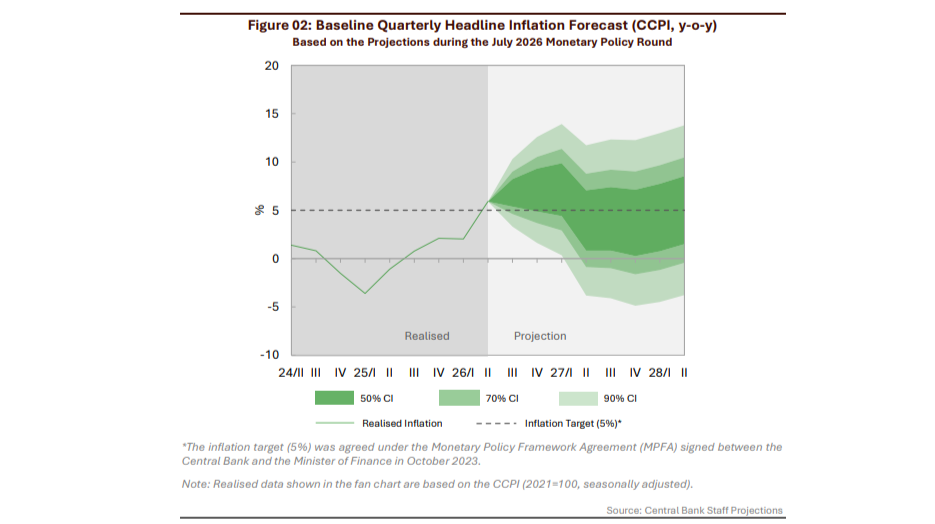
Headline inflation in Sri Lanka has surged above the central bank's 5 percent target, driven primarily by elevated global energy prices, prompting the monetary authority to maintain a tightened policy stance adopted in May 2026.
Sri Lanka's inflation has accelerated significantly in recent months, with the Colombo Consumer Price Index showing headline inflation at 5.9 percent during the second quarter of 2026, according to the Central Bank of Sri Lanka's latest Monetary Policy Report. This marks the end of an eight-quarter period during which inflation had remained below target, representing a sharp shift from the approximately 2 percent average recorded in the first quarter.
The acceleration has been driven largely by supply-side shocks, particularly higher global energy prices filtering through to domestic fuel and electricity costs. Energy and transport inflation climbed notably following upward revisions to fuel, electricity, and liquefied petroleum gas prices. Food inflation has also remained elevated, with volatile price movements in vegetables and fish during June 2026 contributing to broader price pressures. The central bank expects both energy and food inflation to remain high in the near term.
The monetary authority has attributed much of the recent inflation spike to geopolitical tensions in West Asia since late February 2026, which have disrupted global commodity markets and created economic spillovers domestically. The central bank tightened its monetary policy stance in May 2026, ending an accommodative stance that had been maintained since mid-2023. Officials project headline inflation will remain elevated and above the 5 percent target in the coming months before moderating, contingent on the assumption that regional tensions ease.
Looking forward, the central bank has flagged several upside risks to its inflation outlook, including continued uncertainty in global commodity markets and potential adverse weather associated with El Niño. Despite these challenges, the bank noted that inflation expectations remain broadly anchored around the medium-term target. The latest inflation projections have been revised upward compared to previous forecasts, particularly for the remainder of 2026 and into early 2027.