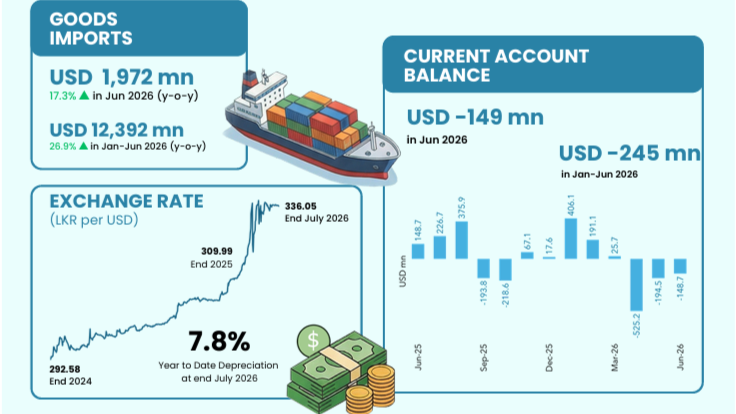
Sri Lanka recorded a current account deficit of $149 million in June 2026, marking the third consecutive monthly shortfall as import costs surge while export earnings and tourism receipts decline.
Sri Lanka's external account deteriorated in June 2026, with the central bank reporting a current account deficit of $149 million for the month. This represents the third consecutive monthly deficit, with the cumulative shortfall for the first half of 2026 reaching $245 million—a significant reversal from the surplus recorded in the same period of 2025.
The widening merchandise trade deficit has been a primary driver of the external imbalance. The trade gap expanded to $5.5 billion during the first six months of 2026, nearly double the $3.3 billion recorded in the corresponding period of 2025. Import expenditure growth has substantially outpaced export earnings, according to the central bank. Fuel import costs have been particularly pressing, with spending on petroleum products rising 40.2 percent year-on-year in June and 58.8 percent for the first half of the year. This surge has been attributed partly to developments in West Asia affecting global energy markets. One bright spot was motor vehicle imports, which fell 27.1 percent month-on-month in June, declining to $1.254 billion for the half-year.
Tourism earnings have also weakened notably. Tourist arrivals declined 9.9 percent year-on-year in June, with tourism revenue falling 10.8 percent to $151 million for the month. First-half tourism earnings dropped 11.8 percent to $1.511 billion compared to 2025. The services account surplus contracted by 33.8 percent. However, worker remittances provided some relief, rising 9.3 percent in June to $695 million, with first-half remittances up 23.2 percent to $4.6 billion. The central bank reported gross official reserves of $6.5 billion by end-June, while the rupee depreciated 7.8 percent against the dollar on a year-to-date basis.